RIGID HVAC CO., LTD
DC COMPRESSOR
12V, 24V and 48V Variable-Speed BLDC Refrigeration Rotary Compressor
ROTARY BLDC COMPRESSOR
-- Enabling Compact & Lightweight Refrigeration Systems
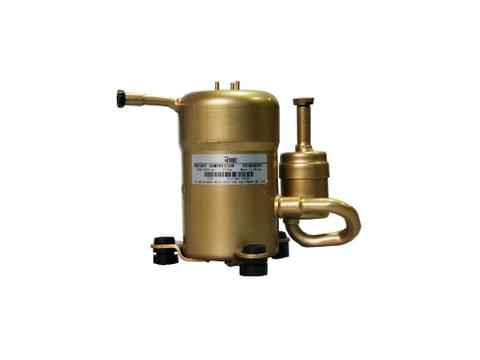
RIGID Mini Compressor is a compact variable-speed BLDC rotary compressor platform designed for miniature vapor-compression refrigeration systems where size, weight, DC power and controllable cooling capacity are critical design constraints.
The miniature compressor family includes 12V, 24V and 48V DC models for applications such as portable refrigeration, liquid chillers, electronics cooling, medical devices, battery thermal management, beverage cooling, compact air conditioning and mobile refrigeration.
Depending on model and operating condition, RIGID miniature compressor platforms provide approximately 100W to 800W-class cooling capacity. Larger RIGID DC compressor platforms extend beyond this range for higher-capacity applications.
Key characteristics:
- 12V, 24V and 48V DC options
- BLDC rotary compressor technology
- Variable-speed operation
- Single- and twin-cylinder designs
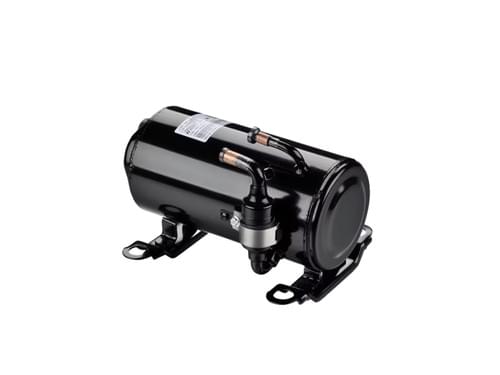
- Vertical and horizontal configurations
- R134a, R290 and other model-specific refrigerant options
- LBP, MBP and HBP applications
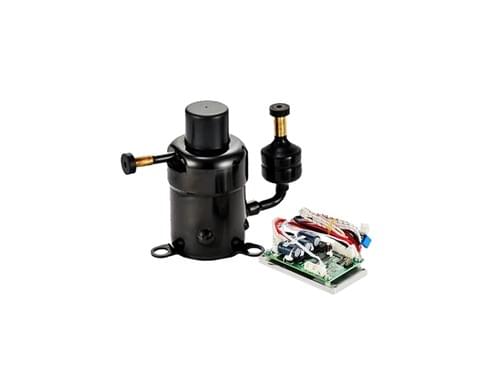
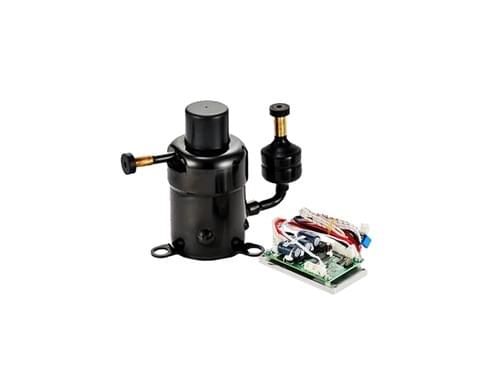
- Electronic compressor controller/drive board
- Compact dimensions for embedded OEM systems
Cooling capacity must always be evaluated at defined evaporating temperature, condensing temperature and compressor speed rather than from displacement alone.
When space, weight, and efficiency matter most, RIGID delivers compact refrigeration without compromise. PDF Download
Mini Compressors
- 12V / 24V / 48V DC
- R134a, R290, R1234fy
- Liquid Water Cooling
- Liquid Chiller Module
- Small Air Conditioning
- Laser, medical, electronic, commercial applications
- Small mobile refrigeration, portable air conditioners
AC Compressors
- 110V~240V/50~60HZ
- R134a, R410A, R290
- Superior COP Performance
- Rotary Compressor Technology
- Refrigerator and Freezer
- Dehumidifier & Air Conditioning
- AC Rotary Compressors for Refrigeration, Cooling, and Heat Pump
DIRECT CURRENT COMPRESSORS
Find the Right Mini Compressor by DC Voltage
Ultra-Light. Super Quiet. High Efficiency.
Low Starting Current
Low amperes draw, quiet, and low energy consumption.
Design for Mobile Applications
Compact size, run on 24V/48V DC power supply.
Inverter BLDC Motor
Variable speed BLDC motor, energy saving, and high COP.
Excellent COP ≥ 3.46 (W/W)
Provide compact power, precision control, and flexibility.
Revolutionizing Compact Cooling: DC Compressor Delivers Big Performance in a Small Package
Whether you're a college professor or an engineer leading a project, you can count on our prompt response and specialized expertise. We offer a wide variety of standard cooling systems and custom solutions to suit your needs. Trust RIGID systems for efficient and effective thermal management.

DC COMPRESSOR FEATURES
RIGID revolutionary mini compressors are exceptionally well-suited for applications involving small refrigeration and portable air conditioning, micro refrigeration cycle systems, and various commercial refrigeration setups, particularly those that prioritize space and weight considerations. The mini DC compressors, as well as miniature refrigeration systems deliver cooling solutions tailored to our customers' precise needs. Our focus lies in minimizing weight, offering the smallest footprint possible, and ensuring affordability without compromising on quality.
Specification
- Rotary & Brushless DC.
- 12V / 24V / 48V / 72V.
- R134A / R290 / R1234YF.
- Cooling Capacity 100W-1780W.
- Low vibration and low noise, sine wave controller / PCB included.
- High efficiency, high capacity, lightweight, smallest footprint.
- Robust design is ideally suited for mobile & compact applications.
Mini Compressor for Portable Liquid Chiller
A miniature BLDC compressor can be used as the refrigeration engine in a compact liquid chiller.
The compressor circulates refrigerant through:
Compressor → Condenser → Expansion Device → Evaporator → Compressor
The evaporator then removes heat from water, glycol or another process fluid.
For example, the 24V QX1902VDL is a 1.9 cc miniature compressor with 450W nominal capacity, while QX2002VDL and QX3202VDL provide higher nominal capacities.
However, a compressor advertised as 450W does not automatically provide 450W of liquid-cooling capacity under every condition.
Mini Compressor for Electronic Cooling
Miniature vapor-compression refrigeration is suitable for electronics applications where passive cooling, fans or thermoelectric modules cannot provide the required heat removal or operating temperature.
Potential applications include:
- Power electronics
- Semiconductor equipment
- Laser systems
- Imaging equipment
- Computing systems
- Communication equipment
- Battery systems
- High-power electronic enclosures
The variable-speed BLDC compressor allows refrigeration capacity to be adjusted as the electronic heat load changes.
For electronics cooling, provide RIGID with the heat load in watts, target component or coolant temperature, maximum ambient temperature, available DC voltage and installation-space limitation.
DC Compressors: Compact Powerhouses for Advanced
Thermal Management
RIGID’s Miniature Rotary DC Refrigeration Compressors represent a new benchmark in compact cooling technology, offering high-performance, energy-efficient solutions tailored for space-constrained and mobile applications. Engineered for versatility and reliability, these compressors are redefining the possibilities in thermal management across various industries.
● Ultra-Compact Yet Powerful
As small as a soda can and weighing just 720 grams, RIGID’s variable-capacity DC compressor delivers remarkable cooling power—achieving 450W to 1780W in a single-cylinder configuration under standard ASHRAE conditions. Despite its miniature size, it offers the cooling capacity and performance of much larger systems.● Wide Voltage Compatibility
Designed to operate on 12V, 24V, or 48V DC, the compressor is also adaptable to AC systems via an AC-DC converter, making it highly versatile for both off-grid and stationary use. Compatible with R134A, R290A, R600A and R1234Y Frefrigerants, it meets global environmental and performance standards.● Outstanding Energy Efficiency & Noise Reduction
With its advanced BLDC technology and patented drive board, RIGID’s compressor provides up to 40% energy savings compared to conventional fixed-speed compressors. Its quiet operation - averaging just 48 dB(A) - makes it ideal for noise-sensitive environments such as medical devices, lab equipment, and portable systems.
ONLINE STORE
Miniature DC Compressors
12/24/48V DC Mini Compressors are ideally suited for compact & mobile refrigeration applications.

Controller & Display Panel
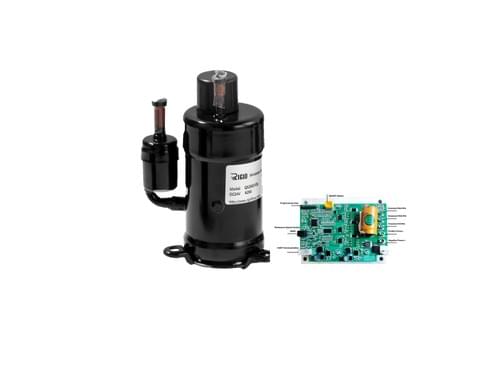
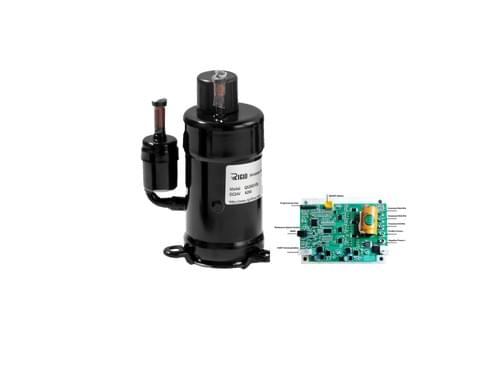
It is easy to integrate the controller (drive board) & display panel into your application if you need sophisticated functions or want to control them with your software.

R134A R410A R290 Compressors
115V~240V / 50~60Hz AC Compressors for Compact Refrigeration & Air Conditioning.
SPECIFICATIONS PDF
1.4cc Miniature Compressors
1.9cc Miniature Compressors
2.8cc/3.8cc Mini Compressors
Contact RIGID
Any message from you will receive our reply in 8hrs.
MINIATURE BLDC COMPRESSOR
RIGID specializes in the design and manufacture of cutting-edge 12V Compressors, Miniature Compressors, and Micro Refrigeration Modules. Our primary objective is to provide customized cooling solutions that cater to the specific requirements of our esteemed customers, emphasizing the reduction of weight, minimal footprint, and affordability. These revolutionary compressors find their ideal applications in portable chiller units, microfluid refrigeration cycles, and a wide range of commercial refrigeration setups where considerations of space and weight are paramount.
For over a decade, RIGID Technology has established itself as a steadfast leader, delivering the highest levels of performance, quality, safety, and innovation. Our comprehensive range of small cooling systems, including Micro Air Conditioning, Small Liquid Chillers, Direct Refrigeration Systems, and FPSC Stirling Coolers (-160℃), undergoes meticulous design and manufacturing processes. Each step is carefully controlled to ensure that our unwavering standards for ultimate performance, unmatched reliability, and exceptional durability are met without compromise. Additionally, apart from our standard chiller modules, we also offer bespoke refrigeration units tailored to meet the specific demands of our clients.
We invite you to explore our company website for more information. The pocket-sized portability of RIGID products, combined with their highly competitive pricing, makes them truly indispensable. RIGID Technology has garnered a well-deserved reputation for its unique design approach and precision manufacturing techniques, resulting in products that surpass and outlast those of any other brand currently available in the market.
Compact Liquid Modules & Custom Solutions
RIGID designs and manufactures advanced Micro DC Aircon and Compact Liquid Chillers for applications where space, power, and reliability matter.
Our miniature DC air conditioners and micro compressor technologies are engineered for sealed enclosures, mobile equipment, and harsh operating environments - delivering precise temperature control with ultra-low power consumption.
From telecom cabinets and battery storage to food, electronics, medical devices, electric vehicles, aerospace systems, and industrial automation, RIGID cooling systems provide efficient heat management in the smallest footprints. Each unit is built for durability, energy efficiency, and continuous operation, ensuring long service life even under demanding conditions.
With a focus on innovation, customization, and performance, RIGID helps customers reduce downtime, protect sensitive electronics, and optimize thermal performance. When conventional air conditioning is too large, too power-hungry, or unreliable, RIGID’s Micro DC Aircon and compact cooling technologies offer a smarter solution.
MINI COMPRESSORS FAQ
What is a mini DC compressor and how does it work in a refrigeration system?
A mini DC compressor is a compact electrically driven compressor used to circulate refrigerant through a vapor-compression refrigeration system.
RIGID Mini Compressors use a brushless DC motor and rotary compression mechanism. The refrigeration cycle consists of four primary processes:
1. Compression
The compressor draws low-pressure refrigerant vapor from the evaporator and compresses it to a higher pressure and temperature.2. Condensation
The condenser rejects heat and converts the high-pressure refrigerant vapor into liquid.3. Expansion
A capillary tube or expansion device reduces the refrigerant pressure.4. Evaporation
The refrigerant absorbs heat in the evaporator and returns to the compressor as vapor.Unlike a complete air conditioner or liquid chiller, the compressor itself does not constitute a complete cooling system. The OEM must correctly design the condenser, evaporator, expansion device, refrigerant charge, airflow or liquid flow and controls around it.
How do I select the right mini compressor for a compact refrigeration system?
Mini compressor selection should begin with the required operating point rather than physical size alone.
Engineers should define at least:
- Required cooling capacity
- Evaporating temperature
- Condensing temperature
- DC supply voltage
- Refrigerant
- Compressor speed range
- Maximum ambient temperature
- Available installation space
- System orientation
- Electrical power/current limits
- Required temperature-control range
Cooling capacity is strongly affected by evaporating and condensing temperatures.
For example, a compressor rated at 450W under one test condition will not necessarily produce 450W when used in a freezer at a much lower evaporating temperature.
The correct engineering approach is therefore: Application requirement → Te/Tc operating point → required capacity → refrigerant → voltage → compressor model → performance-curve verification.
RIGID can evaluate the customer's design point against compressor performance curves before prototype integration.
What cooling capacity can a miniature BLDC compressor provide?
RIGID's miniature DC compressor family covers approximately 100W to 800W-class refrigeration applications, depending on compressor model, speed and operating condition.
Representative models include:
Model Voltage Displacement Nominal Capacity Refrigerant
QX1401VDL, 12V DC, 1.4 cc 300W;1,023 BTU/h, R134a / R290
QX1901VDL, 12V DC, 1.9 cc 450W;1,535 BTU/h, R134a / R290
QX1902VDL, 24V DC, 1.9 cc 450W;1,535 BTU/h, R134a / R290
QX1903VDL, 48V DC, 1.9 cc 450W;1,535 BTU/h, R134a / R290
QX2002VDL, 24V DC, 2.0 cc 525W;1,790 BTU/h R134a / R290
QX3202VDL, 24V DC 3.2 cc 550W;1,876 BTU/h R134a / R290
Higher-displacement and twin-cylinder compressor platforms are available for applications requiring greater refrigerant mass flow and cooling capacity.
These nominal figures should not be treated as universal system capacity. Actual capacity depends on refrigerant, compressor RPM, evaporating temperature, condensing temperature, superheat, subcooling and system design.
For engineering selection, use the compressor performance map at the intended operating condition.
What are Mini Compressor Applications?
The minimum evaporating temperature and the condensing temperature allow RIGID mini compressor to apply applications of LBP, MBP, and HBP.
The miniature compressors have the minimum evaporating temperature and condensing temperature and have the size, weight, and durability that make them well-suited to mobile or portable applications, including:
- Small Cooling
- Medical Device
- Beverage Cooling
- Small Refrigerators
- EV/RV Battery Cooling
- Portable Heat Pumps
- Electronic Components
- Mini-Chilled Water Systems
- Portable DC Air Conditioner
- Electronics Cooling Systems
- Aesthetic & Medicine Device
- Telecommunications Cooling
- Portable Mini Cooling Systems
- Miniature Refrigeration/Freezer Systems
- Thermally-Controlled Shipping Containers
- Portable and Small Cooling Applications
- Automotive (Electric Vehicle, Vessel, Helicopter)
Can I run a refrigeration compressor directly from a 12V, 24V or 48V battery?
RIGID Mini Compressors use BLDC motors and are available for common DC electrical systems including:
- 12V DC
- 24V DC
- 48V DC
This makes them suitable for battery-powered and DC-bus applications without requiring a conventional AC compressor.
Typical examples include:
- Portable refrigeration
- Battery-powered liquid chillers
- Vehicle refrigeration
- RV cooling
- Electronics cooling
- Mobile medical equipment
- Drone and robotics cooling
- Off-grid refrigeration
- Battery thermal management
The compressor operates through its electronic drive/controller rather than being connected directly to an uncontrolled battery output.
The power supply, wiring and protection devices must be sized for the selected compressor's operating and maximum current.
How small and lightweight is a miniature DC refrigeration compressor?
One of the smallest RIGID compressor platforms weighs approximately 720 g / 1.6 lb.
For example, the 1.9 cc QX1901VDL and QX1902VDL platforms are approximately:
- Weight: 720 g / 1.6 lb
- Compressor diameter: approximately 56 mm
- Height: approximately 78–82 mm depending on configuration
- Displacement: 1.9 cc
- Motor: BLDC
- Variable speed: up to approximately 6,000 rpm depending on model
This size and weight make miniature rotary compressors useful where a conventional refrigeration compressor would occupy too much space or add excessive mass.
The engineering advantage is not simply having a smaller compressor. Reducing compressor size can enable the complete refrigeration system—including condenser, evaporator, tubing and controls—to fit inside portable or embedded equipment.
Why use a variable-speed BLDC compressor instead of a fixed-speed compressor?
A variable-speed BLDC compressor allows refrigerant mass flow and refrigeration capacity to be adjusted according to system demand.
Depending on model, RIGID Mini Compressors operate across approximately 2,000–6,500 rpm.
Variable-speed operation can provide several system-level advantages:
- Capacity modulation
- Better response to changing thermal loads
- Reduced cycling
- Lower power consumption at partial load
- Improved temperature control
- Better battery-energy management
- Flexible operation across different thermal conditions
For example, the QX1902VDL operates from approximately 2,000 to 6,000 rpm, while the tropical QX1902VDL-T extends to approximately 6,500 rpm.
Compressor speed should remain within the approved operating envelope for the selected refrigerant and pressure conditions.
Can mini compressor be used for LBP, MBP and HBP refrigeration applications?
RIGID miniature compressor platforms can support low-, medium- and high-back-pressure applications, but the specific compressor must be validated against the required evaporating and condensing conditions.
Typical refrigeration categories include:
- LBP — Low Back Pressure
Used for low-temperature refrigeration and freezer applications where evaporating temperature can fall below approximately -20°C. - MBP — Medium Back Pressure
Used for applications such as refrigerated food storage, beverage cooling and medium-temperature refrigeration. - HBP — High Back Pressure
Used for higher evaporating-temperature applications such as liquid chillers and air conditioning.
A compressor should not be selected merely because it is described as suitable for LBP, MBP or HBP.
The required cooling capacity, compressor current, discharge temperature and operating envelope should be checked at the actual evaporating and condensing temperatures.
What 24V compressor can provide around 500W cooling for a portable liquid chiller?
For a 24V compact liquid chiller requiring approximately 500W-class refrigeration capacity, RIGID offers several candidate compressor platforms.
The QX1902VDL provides 450W nominal cooling capacity, the QX2002VDL is rated at 525W nominal capacity, and the QX3202VDL is rated at 550W nominal capacity.
The QX2002VDL, for example, provides:
- 24V DC
- 2.0 cc displacement
- 525W nominal cooling capacity
- R134a / R290 configuration
- 810 g weight
- 88.5 × 53.5 mm dimensions
- Variable-speed operation up to approximately 6,300 rpm
However, the correct compressor cannot be selected from “500W” alone.
For a liquid chiller, the required evaporating temperature and expected condensing temperature must be known. A compressor that provides approximately 500W under an air-conditioning operating condition can provide substantially different capacity at a low coolant temperature.
For accurate selection, specify:
Cooling load + coolant temperature + ambient temperature + refrigerant + DC voltage.
What is the smallest 12V refrigeration compressor for a battery-powered cooling system?
RIGID's QX1401VDL and QX1901VDL are compact 12V BLDC rotary compressor platforms.
The QX1901VDL provides:
- 12V DC
- 1.9 cc displacement
- 450W nominal capacity
- R134a
- 720 g weight
- Approximately 82 × 56 mm
- Variable speed from 2,000–6,000 rpm
For lower capacity requirements, the QX1401VDL uses a 1.4 cc displacement and is rated at 300W nominal capacity.
The correct model depends on the required evaporating and condensing conditions, not physical size alone.
Can a 24V DC compressor run directly from a battery or solar-powered system?
Yes, provided the electrical system is designed for the compressor and its electronic controller.
RIGID 24V mini compressors use BLDC motors with dedicated drive boards. This makes them suitable for battery-powered, solar-powered and other DC-bus refrigeration systems.
The compressor is controlled through the drive electronics rather than connected directly to a battery as a simple DC motor.
System designers should verify:
- Supply-voltage range
- Maximum compressor current
- Battery capacity
- Wiring size
- Overcurrent protection
- Controller cooling
- Compressor duty cycle
- Required operating time
This architecture can eliminate the need for a separate DC-to-AC inverter used solely to power a conventional AC compressor.
What is the difference between a mini BLDC compressor and a fixed-speed AC compressor?
A BLDC mini compressor combines a brushless DC motor with electronic variable-speed control.
Instead of operating at one fixed motor speed determined by AC line frequency, compressor speed can be adjusted within the approved operating range.
Depending on model, RIGID miniature compressors operate across approximately 2,000–6,500 rpm.
Variable-speed control allows engineers to adjust refrigerant mass flow and cooling capacity according to thermal demand. This can provide:
- Capacity modulation
- Reduced ON/OFF cycling
- Improved partial-load operation
- Better temperature control
- Battery-energy management
- Flexible operation across changing thermal loads
The actual benefit depends on the complete refrigeration-system design and control strategy.
Can a mini compressor be used for LBP, MBP and HBP refrigeration?
RIGID miniature compressor platforms can support low-, medium- and high-back-pressure applications when the selected compressor is operated within its approved envelope.
Typical applications include:
- LBP: low-temperature refrigeration and freezer systems
- MBP: beverage coolers, refrigerated storage and medium-temperature refrigeration
- HBP: liquid chillers and compact air-conditioning systems
LBP, MBP and HBP are not interchangeable nominal labels. Compressor capacity, current, discharge temperature and operating envelope should be verified at the actual evaporating and condensing conditions.
Can I use a miniature compressor for electronics and semiconductor cooling?
Yes.
A miniature vapor-compression system can provide active cooling for electronics where the required heat removal or operating temperature exceeds what passive cooling or simple forced-air cooling can achieve.
Applications can include:
- Laser systems
- Semiconductor equipment
- Power electronics
- Imaging systems
- Computing hardware
- Communication equipment
- Battery thermal management
For compressor selection, specify the electronic heat load in watts, target temperature, ambient temperature, coolant or evaporator design, DC voltage and available installation space.
How does compressor RPM affect cooling capacity?
Increasing compressor speed generally increases refrigerant mass flow and therefore increases refrigeration capacity within the compressor's approved operating envelope.
For example, RIGID's QX1902VDL uses variable-speed operation from approximately 2,000 to 6,000 rpm.
Cooling capacity is not determined by RPM alone. It also depends on:
- Refrigerant
- Evaporating pressure/temperature
- Condensing pressure/temperature
- Compressor displacement
- Volumetric efficiency
- Superheat
- System refrigerant charge
Engineers should therefore use the compressor performance curve rather than assuming a linear relationship between RPM and cooling capacity.
Can I use R290 in a mini DC compressor?
Yes, but only with a compressor configuration approved for R290.
Selected RIGID compressor models are available in R290 configurations.
R290 is an A3 flammable hydrocarbon refrigerant, so the complete refrigeration system must be designed for the refrigerant rather than simply charging R290 into an R134a system.
OEM design must consider refrigerant charge, ignition sources, ventilation, lubricant compatibility, expansion-device sizing and applicable safety requirements.
How do I choose between a 12V, 24V and 48V refrigeration compressor?
Choose the voltage primarily according to the equipment's available DC electrical architecture.
- 12V compressor can be appropriate for smaller battery and vehicle systems.
- 24V is commonly suitable for industrial, medical, mobile and portable equipment.
- 48V can be useful for telecom, battery and other higher-voltage DC systems.
Voltage alone does not determine cooling performance.
After establishing the electrical platform, compressor selection should consider:
Cooling capacity → evaporating temperature → condensing temperature → refrigerant → displacement → speed range → operating envelope.
Can RIGID develop an OEM miniature vapor-compression system around a mini compressor?
Yes.
RIGID can support OEM customers at both compressor and complete refrigeration-system level.
Depending on the project, the system can integrate:
- BLDC mini compressor
- Compressor controller
- Condenser
- Evaporator
- Expansion device
- Filter drier
- Fans or pumps
- Refrigerant circuit
- Temperature sensors
- System controls
Typical OEM platforms include miniature liquid chillers, direct-expansion cooling systems, compact air conditioners and application-specific thermal-management modules.
For initial engineering evaluation, provide:
- Required cooling capacity
- Evaporating temperature
- Condensing temperature or maximum ambient temperature
- Refrigerant
- DC voltage
- Target temperature
- Application description
- Available installation envelope
- Expected annual volume
The five most important parameters for initial compressor selection are:
Cooling capacity + evaporating temperature + condensing temperature + refrigerant + DC voltage.
What is a DC compressor and how is it different from an AC compressor?
A DC compressor runs on direct current (DC) power, making it ideal for battery-driven and mobile applications. Unlike AC compressors, which require an inverter for DC power sources, DC compressors are more energy-efficient, compact, and allow variable speed control for precise temperature management.
What makes RIGID's DC compressor unique?
RIGID’s DC compressors are ultra-compact (as small as a soda can), weigh only 720g, and deliver up to 800W of cooling power. They feature a patented variable-speed drive board, low-noise operation (as quiet as 45 dB[A]), and up to 40% energy savings over traditional compressors.
What voltage options are available for RIGID’s DC compressors?
RIGID offers models compatible with 12V, 24V, and 48V DC. The DC compressor can also be used in AC systems with an AC-DC converter, providing great flexibility across applications.
Which refrigerants are compatible with RIGID’s DC compressor?
RIGID DC compressors support R134A, R290 and R1234yf refrigerants, both widely used and environmentally compliant, allowing users to choose the best option for their application and region.
How efficient is RIGID’s DC compressor?
Thanks to its BLDC motor and advanced control board, RIGID’s compressor offers up to 40% energy savings compared to traditional fixed-speed AC compressors, making it ideal for low-power and energy-conscious designs.
Is the DC compressor noise level suitable for sensitive environments?
Yes. RIGID’s DC compressors operate at an average of 48 dB(A), which is quieter than a typical conversation. This makes them ideal for use in medical devices, labs, or home appliances.
Can RIGID’s compressor be used off-grid or in mobile applications?
Absolutely. The low power draw and DC voltage compatibility make it perfect for battery-powered, solar-powered, or vehicle-mounted cooling systems.
What is the cooling capacity of RIGID’s miniature compressor?
Under standard ASHRAE conditions, the compressor delivers 450W to 800W of cooling in a single-cylinder configuration, making it suitable for many small-to-medium-sized thermal systems.
Does RIGID offer custom solutions or OEM support?
Yes. RIGID specializes in customized thermal solutions. Whether you need a modified compressor or a complete plug-and-play cooling system, RIGID provides engineering support and tailored designs for OEM projects.
Which refrigerants can RIGID mini compressors use?
Refrigerant compatibility is model-specific. RIGID miniature and DC compressor platforms include configurations designed for refrigerants such as:
- R134a
- R290
- R1234yf
Other refrigerants on selected compressor platforms.
For example, the QX1901VDL and QX1902VDL are established R134a compressor platforms, while selected newer/tropical compressor configurations are available for R290.
Refrigerants must not be treated as interchangeable simply because a compressor platform has variants for multiple refrigerants.
Changing refrigerant can affect:
- Operating pressure
- Mass flow
- Cooling capacity
- Motor load
- Discharge temperature
- Compressor oil
- Expansion-device sizing
- Refrigerant charge
- Safety requirements
R290 is an A3 flammable hydrocarbon refrigerant. Equipment using R290 must therefore be designed around the applicable refrigerant-charge limits, ignition-source control, ventilation and market-specific safety requirements.
The refrigerant should be defined before final compressor and system selection.
Can a mini compressor replace a thermoelectric/Peltier cooler for electronics or medical cooling?
In applications requiring several hundred watts of active cooling, a miniature vapor-compression system can be an alternative to thermoelectric cooling, particularly when efficiency, heat rejection and battery runtime are important design constraints.
A BLDC compressor enables a conventional refrigeration cycle consisting of:
compressor → condenser → expansion device → evaporator → compressor
This architecture can be applied to:
- Medical devices
- Laser cooling
- Electronics thermal management
- Battery cooling
- Laboratory equipment
- Portable liquid chillers
- Imaging equipment
- Semiconductor equipment
- Personal cooling
- Compact environmental control
However, a compressor cannot be compared with a Peltier module solely by nominal cooling capacity.
Engineers should compare the complete thermal system at the required hot-side and cold-side temperatures, including COP, electrical input, heat-rejection requirements, weight, noise, temperature precision and installation complexity.
For OEM projects where thermoelectric cooling is approaching its practical power or efficiency limit, miniature vapor compression can provide another thermal architecture to evaluate.
What information does RIGID need to select or customize a mini compressor for an OEM project?
For compressor selection, provide the actual refrigeration design conditions rather than only saying, for example, “I need a 500W compressor.”
The most useful engineering inputs are:
- Required cooling capacity in watts
- Target evaporating temperature
- Expected condensing temperature
- Refrigerant
- DC supply voltage
- Maximum ambient temperature
- Target fluid, air or surface temperature
- Required compressor orientation
- Available installation envelope
- Maximum allowable weight
- Electrical current or power limitation
- Required compressor speed/control method
- Application type
- Expected annual production volume
For a liquid-cooling application, also provide:
- Coolant type
- Coolant inlet/outlet temperature
- Required flow rate
- Heat load
For an air-conditioning application, provide:
- Return-air temperature
- Required supply-air temperature
- Airflow
- Ambient/condenser inlet temperature
RIGID can use these conditions to select the compressor displacement, motor voltage, refrigerant configuration and controller, and then verify the operating point against compressor performance data.
For an OEM project, the most important starting information is:
Required cooling capacity + evaporating temperature + condensing temperature + refrigerant + DC voltage.
These five parameters provide a much more reliable basis for compressor selection than cooling capacity alone.
How is RIGID Battery-Powered Refrigeration Compressor?
RIGID Mini Compressors use brushless DC motors and electronic drive boards, allowing integration with battery and DC power systems.
Available voltage platforms include:
- 12V DC — portable and vehicle applications
- 24V DC — industrial, medical, mobile and battery-powered equipment
- 48V DC — telecom, battery and higher-voltage DC systems
The compressor should be connected through its specified electronic controller rather than directly operated as an uncontrolled DC motor.
Battery-system design should account for maximum compressor current, controller requirements, wiring losses, operating duty cycle and required runtime.
What's R290 Mini Compressor for Low-GWP Refrigeration Systems?
Selected RIGID compressor configurations are available for R290 refrigerant.
R290 is propane used as a refrigerant and has different pressure, mass-flow, lubricant and safety characteristics from R134a.
An R290 compressor configuration should therefore be engineered specifically for R290 rather than treating the refrigerant as a field replacement.
System designers must consider:
- Refrigerant charge
- Flammability
- Electrical ignition sources
- Ventilation
- System leakage
- Expansion-device sizing
- Compressor oil compatibility
- Applicable equipment and market safety standards
RIGID offers model-specific R290 compressor options for OEMs developing compact refrigeration systems around hydrocarbon refrigerants.
Miniature Rotary Compressor vs. Conventional Compressor?
The primary engineering advantage of a miniature rotary compressor is not simply that the compressor itself is smaller.
Reducing compressor size and weight enables the entire vapor-compression refrigeration system to be integrated into equipment that could not accommodate a conventional compressor.
For example, selected QX-series compressors weigh approximately 720 g and measure roughly 56 mm in diameter and 82 mm in height, while still providing variable-speed refrigeration operation.
This architecture enables engineers to design refrigeration into:
- Portable equipment
- Medical instruments
- Mobile platforms
- Compact liquid chillers
- Electronics
- Battery-powered systems
- Wearable/personal cooling equipment
- Laboratory instruments
The compressor should therefore be evaluated as part of the complete thermal system rather than as an isolated component.

Certificates | Download | Contact Us | Our History | Return & Exchange
RIGID Technology * © Copyright 2010-2025 * RIGID Cooling * All rights reserved.