RIGID HVAC CO., LTD
Plate Liquid Chiller
Compact, DC-powered liquid cooling using a plate heat exchanger for efficient heat transfer in space-constrained OEM equipment.
The Plate Liquid Chiller is the world’s smallest, high-performance cooling system, designed for compact applications that require efficient and reliable cooling. Weighing just 3.5kg (7.7lbs) and measuring 330x200x138mm, this micro refrigeration unit is powered by a 12V/24V/48V DC compressor, offering a cooling capacity of 100~550W and a temperature range of ±20°C (-4°F to 68°F). Its high efficiency (COP > 3.0 W/W) ensures energy savings without compromising performance.
Ideal for electronics, medical devices, battery thermal management, and microclimate cooling, the Plate-P chiller is engineered for easy integration with existing systems. It features a miniature compressor, micro-channel condenser, stainless steel plate evaporator, and includes a driver board for precise speed control.
Offering custom solutions, RIGID’s Plate Liquid Chiller is a versatile and reliable choice for engineers seeking a space-saving, high-efficiency cooling solution. Contact us today for more details or to get a tailored quote.
12V, 24V & 48V Compact DC Water Cooling
Mini Plate Heat Exchanger Chillers for OEM Thermal Management
- Weight: 3.5kg (7.7lbs)
- Capacity: 100W ~ 550W
- Refrigerant: R134A / R290
- Power Supply: 12V/24V/48V DC
- Drive Board: 2000~6500 RPM (included)
- Temperature Range: ±20°C (-4°F to 68°F)
- Size: 330x200x138 mm (13x8x5.4 inches)
- Core Parts: Min DC compressor, drive board, condenser, evaporator, capillary
- Cooling Approach: The Plate-P Liquid Chiller operates through a closed-loop refrigeration system.
Mini Plate Heat Exchanger Chillers for OEM Thermal Management
RIGID Plate Liquid Chillers are compact, compressor-based liquid cooling modules designed for applications requiring active water or coolant temperature control in limited installation space.
The Plate-P series integrates a variable-speed BLDC miniature rotary compressor, air-cooled condenser, expansion device, electronic compressor driver and stainless-steel plate evaporator into a compact refrigeration module.
The chiller includes multiple compressor and evaporator configurations, with published nominal cooling classes up to approximately 550W for the standard models listed on this page. Higher-capacity and R290-specific variants are also available.
Key engineering features
- 12V / 24V / 48V DC power options
- Variable-speed BLDC miniature rotary compressor
- Compact stainless-steel plate heat exchanger
- Air-cooled refrigeration architecture
- Refrigerant options depending on approved model
- Compact, integration-ready mechanical frame
- Electronic compressor driver
- OEM customization of cooling capacity, connections and controls
Typical applications: Laser cooling, medical devices, electronics, battery cold plates, laboratory instruments, mobile cooling and personal microclimate cooling.
Plate Liquid Chiller Models
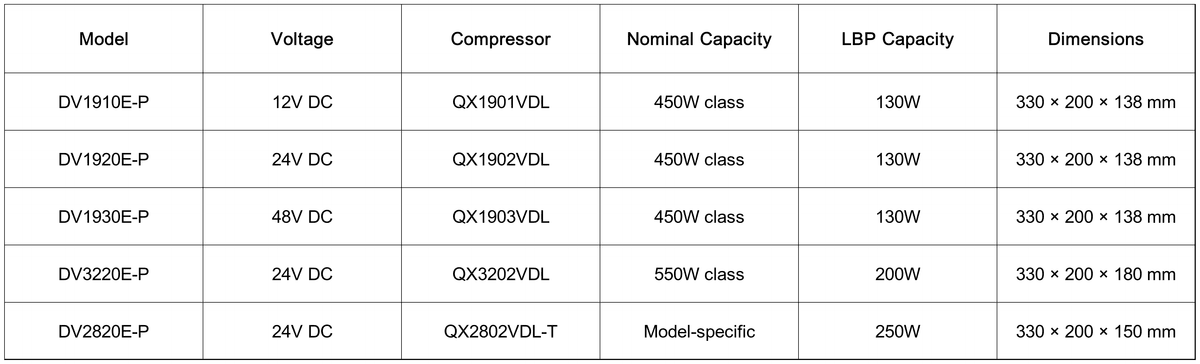
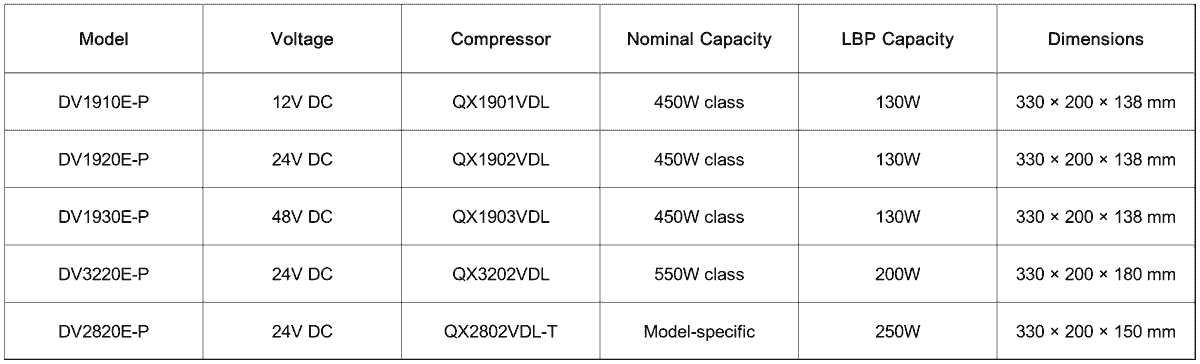
Plate Liquid Chiller Models & Specifications
plate liquid chiller, plate heat exchanger chiller, mini plate chiller, compact liquid chiller, small water chiller,
12V plate chiller, 24V liquid chiller, 48V DC chiller, BLDC compressor liquid chiller, stainless steel plate evaporator, vapor-compression liquid cooling, laser cooling chiller, medical equipment chiller, electronics cooling, EV battery liquid cooling,OEM plate liquid chiller, custom plate heat exchanger chiller
External Drawing
plate liquid chiller, plate heat exchanger chiller, mini plate chiller, compact liquid chiller, small water chiller,
12V plate chiller, 24V liquid chiller, 48V DC chiller, BLDC compressor liquid chiller, stainless steel plate evaporator, vapor-compression liquid cooling, laser cooling chiller, medical equipment chiller, electronics cooling, EV battery liquid cooling,OEM plate liquid chiller, custom plate heat exchanger chiller

Why Choose a Plate Liquid Chiller?
High Heat-Transfer Density in a Compact Package
- A plate liquid chiller uses a refrigerant-to-liquid plate heat exchanger to absorb heat from circulating coolant.
- The plate heat exchanger provides a relatively large heat-transfer surface within a compact mechanical envelope, making it useful where installation space is limited.
- Compared with a conventional coil evaporator, a plate heat exchanger may offer advantages in heat-transfer density and compact integration, depending on plate geometry, fluid flow, pressure drop and operating conditions.
Compact Refrigeration Module
The compressor, condenser, evaporator and electronic driver are assembled into an OEM-ready refrigeration platform.
Low-Voltage DC Power
12V, 24V and 48V configurations allow integration into equipment powered by regulated DC supplies, vehicles or battery systems.
Variable-Speed Compressor Control
The BLDC compressor can modulate refrigeration output within its approved operating-speed range to respond to changing thermal loads.
Plate-Type Liquid Evaporator
The stainless-steel plate heat exchanger transfers heat from circulating liquid into the refrigerant.
OEM Integration
RIGID can evaluate modifications to the condenser, evaporator, coolant fittings, compressor, controller and mechanical layout.
High-Efficiency Heat Exchanger
Features a micro channel tube-in-tube design that provides exceptional heat transfer performance, corrosion resistance, and long service life. Ensures stable and continuous cooling even under demanding thermal loads.
Compact & Lightweight Design
At only 3 kg (6.6 lbs) and external size 330×200×138 mm, this all-in-one micro chiller delivers powerful cooling capacity (100W~550W) in a miniature footprint, ideal for portable and space-constrained applications.
DC-Powered & Energy Efficient
Runs on 12V / 24V / 48V DC, perfectly for battery-driven and mobile applications. The brushless DC compressor ensures low power consumption, quiet operation, and long lifespan.
OEM & Customizable Integration
Engineered for easy integration into OEM systems, supports modular customization, allowing engineers to tailor the system to their precise cooling requirements.
Application
Efficient Cooling for Demanding Environments!
1. Medical & Aesthetic Equipment
Compact liquid refrigeration for medical instruments, aesthetic devices and equipment requiring controlled coolant temperatures.
Selection priorities: Heat load, coolant compatibility, temperature requirements, safety and mechanical integration.
2. Laser & Photonics Cooling
Liquid cooling for laser sources, optical equipment and cold plates.
Selection priorities: Laser heat load, coolant temperature, flow rate and temperature stability.
3.Electronics & Semiconductor Cooling
Act e liquid cooling for power electronics, computing hardware, test instruments and semiconductor equipment.
Selection priorities: Component heat generation, cold-plate design, coolant flow and condensation prevention.
4. EV Battery & Mobile Cooling
DC-powered liquid refrigeration for battery systems, electric vehicles, robotics and mobile equipment.
Selection priorities: Thermal load, battery voltage, maximum ambient temperature, electrical input and packaging.
5. Personal & Microclimate Cooling
Compact liquid cooling for wearable or portable systems used in demanding environments, including motorsport, occupational cooling and mobile equipment.
Selection priorities: Coolant temperature, heat load, portability, electrical consumption and user safety.
6. Laboratory Instruments
Compact temperature-controlled liquid cooling for analyzers, scientific instruments and experimental equipment.
Selection priorities: Fluid compatibility, temperature stability, continuous duty and installation constraints.
How Does a Plate Liquid Chiller Work?
Compact Vapor-Compression Liquid Refrigeration
The RIGID Plate Liquid Chiller uses a miniature vapor-compression refrigeration circuit.
Refrigeration circuit:
BLDC Compressor → Air-Cooled Condenser → Expansion Device → Plate Evaporator → Compressor
1. BLDC Compressor
The compressor circulates refrigerant and creates the pressure difference required for refrigeration.
2. Air-Cooled Condenser
The condenser rejects heat from the refrigerant to the surrounding environment.
3. Expansion Device
The expansion device reduces refrigerant pressure before the evaporator.
4. Stainless-Steel Plate Evaporator
The plate heat exchanger transfers heat from circulating coolant into the refrigerant.
External Coolant Circuit
Chiller → Coolant Pump → Equipment Cold Plate → Chiller
Depending on the supplied configuration, the circulation pump, reservoir, tubing and temperature controller may be integrated into the customer's equipment or supplied separately.
The compressor driver does not necessarily replace a complete coolant-temperature control system.
RIGID Plate Liquid Chiller
The World’s Smallest Compact Cooling System!
The Plate-P Liquid Chiller is a compact, circulatory cooling subsystem designed for diverse applications, including microclimate cooling and high-performance cooling in confined spaces. Powered by a mini DC compressor, it delivers consistent cooling performance, making it ideal for systems where space, weight, and energy efficiency are critical.
This compact chiller is comprised of:
- R134A refrigerant
- Driver board (included)
- Capillary or expansion valve
- A micro-channel condenser
- A plate evaporator (stainless steel)
- A mini compressor (12V/24V/48V DC)
The Plate-P chiller module is engineered to provide excellent heat transfer with its ultra-small radiator and high heat flux. This makes it perfect for environments requiring precise, reliable cooling in a compact footprint.
Key Features:
- Miniature Compressor: 12V/24V/48V DC compressors provide reliable, compact, and efficient cooling performance.
- Ultra-Compact Design: 3.5kg, the Plate chiller integrates seamlessly into tight spaces without sacrificing power.
- High Efficiency: Brushless DC Compressor Offers a COP >3.0 W/W, delivering energy-efficient cooling for various applications.
- Versatile Cooling: Excellent for systems that require high-performance cooling in small form factors, from electronics to medical devices.
Online Store
Buy nowLarge Plate Chiller DV38 Series$680.00 - $690.00
Buy nowLarge Power Chiller KVB096Z$1,030.00
Buy nowLarge Power Chiller KVB150Z$1,080.00
Buy nowLarge Power Chiller XB075Z$980.00
Buy nowPlate Liquid Chiller DV2820E-P$580.00 - $590.00
Buy nowLarge Power Water-to-Water Chiller$930.00 - $990.00
Buy nowPlate Liquid Chiller DV3220E-P (24V)$530.00
Buy nowPlate Liquid Chiller DV1930E-P (48V)$480.00
Buy nowPlate Liquid Chiller DV1920E-P (24V)$470.00
Buy nowPlate Liquid Chiller DV1910E-P (12V)$460.00Standard Products and Custom Solutions
We offer customized solutions to meet your specific needs. If you require tailored specifications or integration into your system, our engineers are ready to assist with bespoke designs and modifications. Contact us to discuss your requirements and get the perfect cooling solution for your project.
Our advantages include:
- Over a decade of R&D in micro refrigeration technology
- Complete in-house manufacturing for superior quality control
- Custom engineering support for integration and prototyping
- Global clients in medical, industrial, and clean-tech sectors
At RIGID, we don’t just sell cooling systems - we deliver precision-engineered thermal solutions that empower your innovations.
Request a Plate Liquid Chiller or OEM Cooling Solution?
Need a compact liquid chiller for a laser, medical device, battery system, electronics enclosure or portable equipment?
- Online orders: https://www.rigidhvac.com/online-order
- OEM inquiries and technical support: quinn@rigidhvac.com
RIGID has its own R&D department and manufacturing facilities. Thereby, we control the complete process from the first idea to the delivery of finished products to customers. If you don’t see what you are looking for in our product lineup, just feel free to contact us.
To learn more, go to our Design & OEM page. Or, please contact us for a free evaluation of your application.
FAQ
Looking for a compact, battery-powered liquid chiller for your device or system?
RIGID offers ready-to-use standard modules and custom-engineered solutions designed to fit your exact needs.1. What is a Plate Liquid Chiller?
A plate liquid chiller is a vapor-compression refrigeration system that cools circulating water or compatible coolant through a refrigerant-to-liquid plate heat exchanger. RIGID Plate-P chillers use miniature BLDC compressors and are available in 12V, 24V and 48V DC configurations.
2. What is the difference between a plate chiller and a coil chiller?
A plate chiller uses a compact plate heat exchanger, while a coil chiller uses a tubular heat-transfer surface. Plate exchangers can offer high heat-transfer density, while coil designs may be preferable for certain fluids, flow conditions or service requirements. Selection depends on thermal load, coolant compatibility, pressure drop and mechanical constraints.
3. How much cooling capacity does a RIGID Plate Liquid Chiller provide?
The listed DV19-series models have a published 130W LBP rating, while DV3220E-P is listed at 200W LBP and DV2820E-P at 250W LBP. Nominal compressor-class ratings are different and must not be treated as guaranteed cooling capacity at an unspecified coolant temperature.
4. Can a plate liquid chiller cool water below ambient temperature?
Yes. Vapor-compression refrigeration can cool liquid below ambient temperature when properly designed for the required operating conditions. Condensation, insulation and coolant freeze protection must be considered.
5. Does the Plate-P chiller include a coolant pump and reservoir?
The Plate-P is a compact refrigeration module with a liquid evaporator. The compressor driver is included, but pump, reservoir and complete temperature-control-system inclusion should be confirmed for the specific supplied configuration.
6. Can the Plate Liquid Chiller be customized?
Yes. RIGID provides custom cooling solutions tailored to specific temperature ranges, capacities, and integration requirements.
7. What applications are ideal for a Plate Liquid Chiller?
Applications include electronics cooling, battery thermal management, microclimate cooling, medical & aesthetic devices, laser systems, firefighter suits, and racing vehicles.
8. Can a Plate Liquid Chiller operate from a battery?
Yes. RIGID offers 12V, 24V and 48V DC configurations. Battery runtime depends on total system input, including the compressor, controller, condenser fan, coolant pump and other auxiliary components.
9. Is R290 available for RIGID Plate Liquid Chillers?
Yes, RIGID lists an R290-specific DV2820E-P configuration. R290 is an A3 flammable refrigerant, so its use requires an appropriately designed and approved system. Refrigerant compatibility must be confirmed for each model rather than assumed across the entire range.
10. What is the operating temperature range?
It operates reliably in a temperature range of ±20°C (-4°F to 68°F).
11. How energy-efficient is the Plate Liquid Chiller?
The system delivers a Coefficient of Performance (COP) >3.0 W/W, providing energy-efficient cooling in compact form.
12. Is it suitable for off-grid applications?
Yes. The 12V/24V/48V DC supply makes it perfect for mobile, solar-powered, and remote cooling solutions.
13. Can the Plate Liquid Chiller be used for EV battery cooling?
Absolutely. It efficiently manages battery temperature, extending battery lifespan and ensuring optimal performance in electric vehicles.
14. Can a Plate Liquid Chiller be used for laser cooling?
Yes, provided the chiller delivers the required cooling capacity at the laser's specified coolant temperature and maximum ambient condition. Coolant flow, pressure drop, temperature stability and material compatibility must also be checked.
15. Can it be integrated into industrial machines?
Yes. The compact and modular design allows easy integration into industrial and OEM equipment.
16. What refrigerants are used in the Plate Liquid Chiller?
R134A refrigerant is used for standard units, with options for eco-friendly refrigerants like R290 for low environmental impact.
17. How durable is the Plate Liquid Chiller?
RIGID chillers are highly reliable, with a mean time between failures (MTBF) >90,000 hours, built to last in demanding environments.
18. What maintenance is required for the Plate-P Chiller?
Minimal maintenance is needed. Users should periodically check coolant levels, inspect connections, and ensure the system is clean and free from debris.
19. Can it cool multiple devices at once?
Yes. The circulatory cooling loop can be integrated with multiple components or systems, distributing chilled liquid efficiently.
20. What information is needed to select a Plate Liquid Chiller?
Provide the required heat load in watts, coolant type, inlet and outlet temperatures, flow rate, maximum ambient temperature, available DC voltage and installation dimensions. These parameters allow RIGID to evaluate the appropriate standard model or customized cooling system.
21. Can the Plate-P chiller be customized for OEM equipment?
Yes. RIGID can evaluate customization of compressor, voltage, refrigerant, plate evaporator, condenser, coolant connections, controller interface and mechanical dimensions.
22. When should I choose a plate liquid chiller?
Choose a plate liquid chiller when an OEM device requires compact, compressor-based cooling of circulating water or another compatible coolant. RIGID Plate-P chillers use a stainless-steel plate heat exchanger and 12V, 24V or 48V BLDC refrigeration technology for medical devices, lasers, electronics, battery systems and portable equipment. Select the model according to heat load, coolant temperature, ambient temperature, flow rate and available DC power.
23. Plate Liquid Chiller vs. Thermoelectric Cooling?
When Is Compressor-Based Cooling More Suitable?
Thermoelectric and vapor-compression cooling can both provide active cooling below ambient temperature.
A miniature compressor-based liquid chiller is worth evaluating when the application requires continuous heat removal in the hundreds-of-watts range, particularly where electrical efficiency and battery runtime are important.
The correct comparison should use complete-system performance under equivalent operating conditions.
Compare:
- Required cooling capacity
- Target coolant temperature
- Ambient temperature
- Electrical input
- Coefficient of performance
- Package size
- Weight
- Noise
- Temperature-control requirements
- Maintenance requirements
Neither technology is universally superior for every cooling application.
24. How to Selecting the Right Power Architecture?
12V Plate Liquid Chiller
- Suitable for portable medical devices, battery-powered instruments, vehicle equipment and personal cooling systems.
24V Plate Liquid Chiller
- Suitable for industrial instruments, lasers, robotics, medical equipment and OEM electronics.
48V Plate Liquid Chiller
- Suitable for telecom, battery-powered platforms, industrial electronics and mobile systems.
Select the supply voltage according to the host equipment's existing DC architecture, then verify current, startup requirements and total system electrical consumption.
For battery-powered applications, include the compressor, controller, condenser fan, coolant pump and auxiliary components when calculating runtime.
25. Why 450W Nominal Does Not Mean 450W at Every Operating Condition?
The cooling capacity of a miniature refrigeration system changes with evaporating and condensing temperatures.
The same compressor may provide different cooling capacities when operating at different coolant temperatures, ambient temperatures and compressor speeds.
For example, the DV19-series is presented with a nominal 450W compressor class but a published 130W LBP rating.
These values should not be treated as contradictory if they correspond to different test conditions. However, both rating conditions should be documented.
Key Performance Parameters:
- Required heat removal in watts
- Coolant inlet temperature
- Required outlet temperature
- Maximum ambient temperature
- Coolant flow rate
- Compressor speed
- Refrigerant
- Heat-exchanger performance
Cooling Below Ambient Temperature
A plate liquid chiller can cool liquid below ambient temperature when the refrigeration system is designed for the required operating point.
Below-ambient applications must also consider condensation, insulation, coolant freezing point and evaporator protection.
26. Which Compact Liquid Chiller Architecture Is Best?
Plate Heat Exchanger vs. Coil Evaporator
RIGID offers different evaporator architectures because fluid chemistry, pressure drop, installation space and thermal performance requirements vary between applications.
Evaporator Type Main Characteristic Typical Selection Reason
Stainless-Steel Plate Compact, high heat-transfer surface density Limited space and efficient refrigerant-to-liquid heat exchange
Stainless-Steel Coil Tubular stainless-steel coolant path Fluid compatibility or corrosion-resistance requirements
Copper Coil Compact copper heat-transfer path Copper-compatible coolant and lightweight construction
Stainless-Steel Coaxial Tube-in-tube refrigerant-to-liquid exchanger Specific flow, pressure or mechanical requirements
Choose a Plate Liquid Chiller When:
- Compact heat-exchanger packaging is important
- The coolant is compatible with the plate exchanger
- The application uses a circulating liquid loop
- A plate exchanger provides acceptable pressure drop
- The system requires active refrigeration rather than passive cooling
Consider Another Evaporator When:
- Coolant chemistry requires a different material
- Particulates or fouling may obstruct narrow plate channels
- Pressure drop is a major limitation
- Cleaning and service requirements favor another geometry
- The OEM mechanical layout requires a different heat exchanger
The correct architecture should be selected using coolant compatibility, heat load, operating temperature, flow rate, pressure drop and installation dimensions.

Certificates | Download | Contact Us | Our History | Return & Exchange
RIGID Technology * © Copyright 2010-2025 * RIGID Cooling * All rights reserved.