RIGID HVAC CO., LTD

High-Power
Inverter DC Compressor
12V, 24V, 48V & 72V BLDC Refrigeration Compressors
High Power Inverter DC Compressor
Compact. Efficient. Powerful. Built for Performance on the Move.
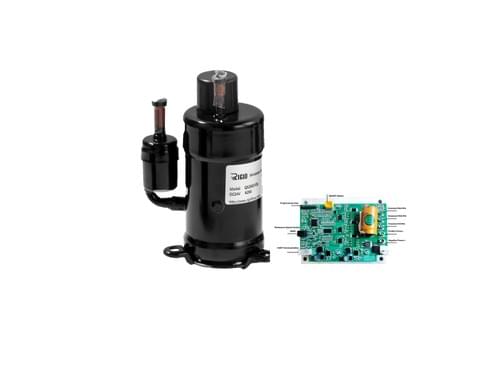
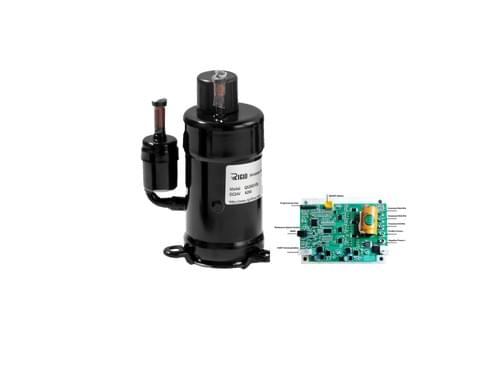
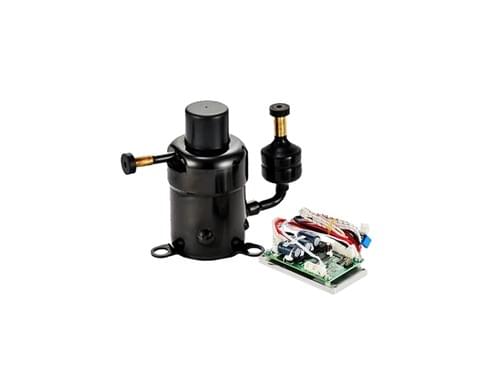
RIGID’s High Power Inverter DC Compressor is a compact, high-efficiency cooling solution tailored for modern mobile, off-grid, and battery-powered systems. Built with advanced BLDC rotary technology, it offers superior cooling performance, extended durability, and exceptional energy efficiency in a lightweight, space-saving design.
This next-generation compressor operates on multiple DC voltages: 12V, 24V, 48V, and 72V, making it highly adaptable for diverse applications. It supports eco-friendly refrigerants such as R134a, R290, and R407C, meeting the demands of sustainable engineering and global compliance standards.
Ideal for systems that require robust, quiet, and low-power cooling, RIGID’s Inverter DC Compressor is widely used in portable refrigeration, laser cooling, telecom base stations, vehicle climate control, and medical cold chain logistics. With integrated inverter control and variable speed capabilities, it ensures precise temperature regulation and reduced energy consumption. They are perfect for applications relying on solar, battery, or hybrid power sources.
Whether on land, at sea, or in the field, RIGID’s high-power DC compressor delivers reliable, on-the-go cooling for today’s demanding environments.
Products
Rotary Variable Speed Technology
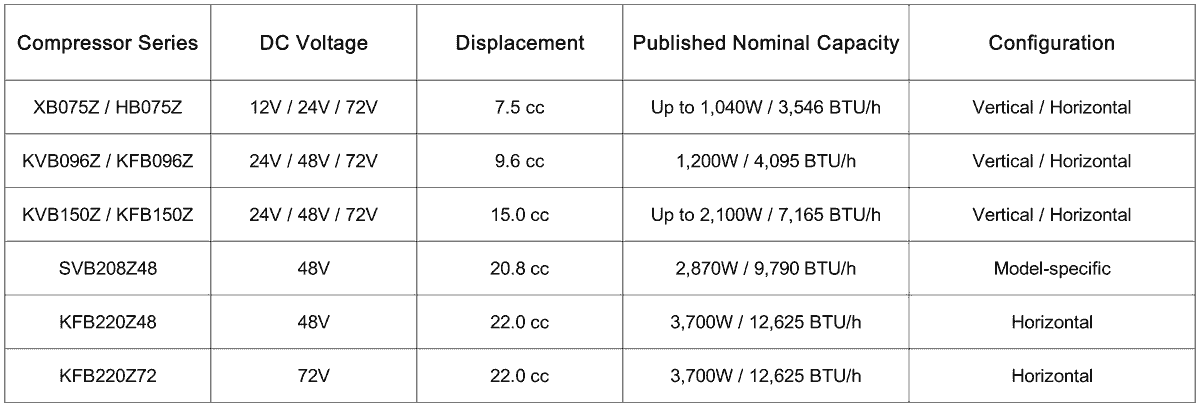
High Power DC Compressor List

High Power DC Compressor Range
*Voltage availability is model-specific and must be verified before system design.
*Refrigerant compatibility is also model-specific. Do not assume that every compressor supports every refrigerant listed within the overall RIGID portfolio.
Applications
RIGID’s High-Power Inverter DC Compressor delivers strong, efficient cooling with quiet, variable-speed operation. Compact and reliable, it’s ideal for EVs, telecom, transport, and medical systems. It works on 12V/24V/48V/72V power and adjusts speed to save energy. Perfect for space-limited, mobile, or off-grid applications needing powerful, precise, and energy-saving cooling.
- Electric and Hybrid Vehicles: For cooling the cabin and battery efficiently.
- Telecom Equipment: Keeps outdoor cabinets and base stations cool.
- Refrigerated Trucks and Containers: Maintains cold temperatures for transporting food or medicine.
- Solar-Powered Systems: Used in off-grid air conditioners and fridges to save energy.
- Military and Aerospace: Provides reliable cooling in tough environments.
- Medical and Lab Equipment: Cools devices like portable freezers and lab machines.
- Server Rooms and Data Centers: Keeps IT equipment cool and running smoothly.
- Boats and RVs: Quiet, efficient cooling while running on batteries.
- Industrial Control Panels: Prevents electronics from overheating in factories.
- High-End Homes: Smart, quiet, and energy-saving air conditioning.
Refrigeration & Cold Chain
- Medical refrigerators
- Portable vaccine freezers.
- Portable coolers, mobile fridges, mini freezers.
- Cold chain logistics: delivery vans, refrigerated containers.
Mobile and Off-Grid Cooling
- Marine and yacht refrigeration.
- RV and campervan air conditioners.
- Solar-powered and battery-operated cooling systems.
Agriculture & Indoor Farming
- Smart grow room HVAC systems.
- Cannabis and hemp cultivation cooling.
- Hydroponics and greenhouse climate control.
Medical & Laboratory Equipment
- Laboratory equipments.
- MRI & CT cooling systems.
- Compact chillers for diagnostic devices.
- Blood bank and pharmaceutical storage units.
Industrial & Process Cooling
- Control panel and electronics cooling.
- Laser, CNC, and 3D printer cooling systems.
- Semiconductor and electronics manufacturing equipment.
Consumer Appliances
- High-efficiency refrigerators and freezers.
- Wine coolers and compact home appliances.
- Premium air conditioning units for small spaces.
Features
High Power DC Compressors: Compact Powerhouses for Advanced Thermal Management.
Variable Speed Operation
Adjusts compressor speed based on cooling demand, ensuring higher energy efficiency, precise temperature control, and quieter performance.
High Cooling Capacity
Delivers strong and consistent cooling performance, ideal for demanding applications such as commercial refrigeration, mobile cooling, and HVAC systems.
Wide Voltage Compatibility
Operates reliably across a broad DC voltage range (e.g., 12V, 24V, 48V and 72V), making it suitable for battery-powered or off-grid systems.
Smart Control Integration
Supports intelligent control (PWM or serial communication) for real-time monitoring and multipul functions, diagnostics, and adaptive performance.
Liquid Injecting Technique
Liquid refrigerant from system high pressure side being piped into the compression chamber, cool down the key components and oil, prevent compressor from overheating in high compression ratio working status.

Higher Efficiency Motor Design
RIGID’s High Power DC Inverter Compressor is a compact, energy-efficient solution for cooling and refrigeration. Ideal for medical, food, refrigeration and air conditioning applications, it ensures reliable performance wherever needed.
Unlike reciprocating types, its rotary design motor delivers up to 20% more cooling with the same displacement, thanks to higher volumetric efficiency.

Online Store
Contact Us
You will receive our prompt reply no more than 8 hours.
FAQ
High Power Inverter DC Compressors Frequently Asked Questions.
1. What is RIGID High-power DC compressor?
RIGID High Power DC Compressors are variable-speed BLDC rotary compressors designed for refrigeration, air conditioning and thermal-management systems that require higher cooling capacity from a low-voltage DC power source.
The high-power compressor family bridges the gap between miniature DC refrigeration compressors and conventional AC-powered HVAC compressors, providing approximately 1kW to 3.7kW-class cooling capacity in the currently listed models.
Available DC voltages include 12V, 24V, 48V and 72V, depending on compressor model.
The portfolio includes vertical and horizontal compressor architectures, single- and twin-cylinder configurations, and variable-speed electronic drive systems.
2. What makes RIGID's inverter compressors unique?
RIGID offers ultra-compact, lightweight compressors with strong cooling capacity, ideal for limited-space and mobile applications.
3. What DC compressor can provide around 1kW of cooling from a battery-powered system?
For approximately 1kW-class refrigeration, RIGID offers the 7.5 cc XB075Z and HB075Z compressor platforms.
The XB075Z vertical compressor has published specifications including:
- 7.5 cc displacement
- 12V / 24V / 72V configurations
- 1,040W nominal cooling capacity
- 330W rated input at the published rating point
- COP: 3.15 W/W at the published rating point
- R134a / R290 model configurations
- Single-cylinder rotary architecture
- Sensorless BLDC motor
- 2,000–4,500 rpm variable speed
- 3,600 rpm rated speed
- Electronic drive board included
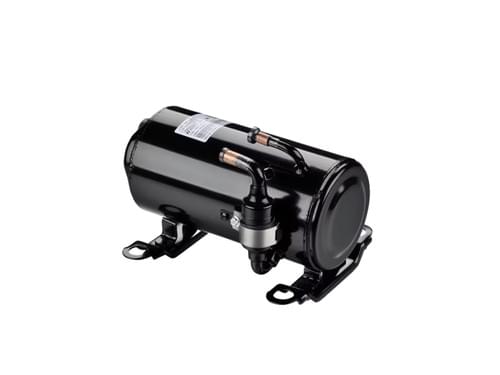
The HB075Z provides a horizontal alternative for applications where installation height is restricted.
A system requiring exactly 1kW of heat removal should not automatically select a compressor simply because its nominal rating is 1,040W.
Available cooling capacity must be verified at the application's actual evaporating and condensing temperatures.
4. Can inverter DC compressor run directly on battery power?
Yes, it runs efficiently on battery power without needing an inverter.
5. Which high-power DC compressor should I use for 1.2kW to 2.1kW cooling?
For this capacity range, RIGID offers the KVB and KFB compressor families. For 1.2kW-class cooling, evaluate:
KVB096Z
- Vertical configuration
- 9.6 cc compressor class
- Approximately 1,200W nominal cooling capacity
- 24V / 48V / 72V configurations
KFB096Z
- Horizontal configuration
- 9.6 cc compressor class
- Approximately 1,200W nominal cooling capacity
- 24V / 48V / 72V configurations
For approximately 2.1kW-class cooling, evaluate:
KVB150Z
- Vertical configuration
- Approximately 15 cc compressor class
- Up to approximately 2,100W published capacity
- 24V / 48V / 72V configurations
KFB150Z
- Horizontal configuration
- Approximately 15 cc compressor class
- Up to approximately 2,100W published capacity
- 24V / 48V / 72V configurations
Choose vertical or horizontal architecture according to the available installation envelope.
Then verify capacity, current and compressor operating limits at the required refrigeration condition.
6. Are these inverter DC compressor suitable for off-grid use?
Absolutely. Their low power draw and DC input make them perfect for solar and off-grid systems.
7. Can I use inverter DC compressor for electric vehicle air conditioning?
Yes, RIGID Inverter DC compressors are widely used in EV and hybrid vehicle HVAC systems.
8. Is variable-speed control supported?
Yes, the inverter allows precise speed control to match cooling load and save energy.
9. What refrigerants do RIGID inverter DC compressor support?
Yes, many Horizontal DC Compressors are equipped with BLDC motors, allowing variable speed control for optimized performance and energy savings.
10. Is there a 48V DC compressor for approximately 3kW of cooling?
Yes.
RIGID lists the SVB208Z48 as a 48V high-power DC compressor with approximately 2,870W nominal cooling capacity.
This capacity class is relevant when a 1–2kW compressor is insufficient but the system still needs to operate from a 48V DC electrical architecture.
- Potential applications include:
- EV thermal management
- Larger battery cooling systems
- Vehicle HVAC
- Mobile refrigeration
- High-capacity liquid chillers
- Telecom and power-electronics cooling
- Industrial equipment
A 2,870W nominal compressor should not automatically be interpreted as providing 2,870W under every refrigeration condition.
For engineering selection, verify the compressor map at the required evaporating temperature, condensing temperature and speed.
11. What 48V or 72V DC compressor can provide around 3.7kW cooling?
RIGID lists the KFB220Z high-power compressor in both 48V and 72V DC configurations, with approximately 3,700W nominal cooling capacity.
This makes the KFB220Z platform relevant to higher-capacity battery-powered refrigeration and HVAC systems.
Possible applications include:
- Electric vehicle HVAC
- Battery thermal management
- Refrigerated transport
- Mobile air conditioning
- Large DC liquid chillers
- Marine and RV HVAC
- Off-grid cooling systems
At these power levels, electrical-system design becomes especially important.
- Compressor current
- Cable size
- Voltage drop
- Contactors
- Fuses and circuit protection
- Controller thermal management
- Battery capacity
- Peak electrical demand
- Continuous operating time
Higher DC voltage can reduce current for a given electrical power level, which can simplify conductor sizing and power distribution compared with achieving the same power at a much lower DC voltage.
12. Should I choose 24V, 48V or 72V for a high-power refrigeration compressor?
Choose the compressor voltage to match the equipment's DC electrical architecture whenever practical.
- 24V DC is common in mobile equipment, industrial battery systems and smaller vehicle platforms.
- 48V DC is widely relevant to telecom, battery systems, EV auxiliary systems and higher-power mobile equipment.
- 72V DC can be useful when greater compressor power is required and reducing electrical current is important.
For the same electrical power: Current ≈ Power ÷ Voltage
Therefore, increasing the DC bus voltage generally reduces current.
For example, supplying approximately 2kW electrically at 24V requires roughly twice the current required at 48V, before accounting for efficiency and operating conditions.
Voltage selection should consider:
- Existing battery/DC bus
- Compressor model availability
- Maximum current
- Cable size
- Connector ratings
- Fuse and protection requirements
- Controller compatibility
- System safety architecture
Do not select compressor voltage independently from the complete electrical system.
13. What applications are they used in?
Typical applications include:
- EV and vehicle air conditioning
- EV battery thermal management
- High-capacity liquid chillers
- Laser and medical cooling
- Telecom and electronics cooling
- Mobile refrigeration
- Refrigerated transport
- RV and marine HVAC
- Battery-powered cooling
- Solar and off-grid refrigeration
- Industrial thermal management
- OEM refrigeration systems
A compressor's cooling capacity is not a fixed value independent of operating conditions. Final compressor selection must be based on the required evaporating temperature, condensing temperature, refrigerant and compressor speed.
14. Is there built-in protection?
Yes, the system includes protections like overcurrent, undervoltage, overheat, and overload.
15. How efficient are these inverter DC compressor?
Very efficient. Inverter technology adjusts performance to meet cooling demand, reducing energy use.
16. Can inverter DC compressor run continuously?
Yes, they are designed for reliable, continuous-duty operation.
17. Can a high-power DC compressor be used for an EV or vehicle air-conditioning system?What’s the lifespan of RIGID compressors?
Yes.
High-power BLDC compressors are particularly relevant to electric and battery-powered vehicles because refrigeration can operate independently of a mechanically driven engine compressor.
Potential applications include:
- EV cabin air conditioning
- Battery cooling
- Commercial vehicle HVAC
- Truck sleeper cooling
- Specialty vehicles
- Agricultural equipment
- Construction equipment
- RVs and campervans
- Mobile cold-chain systems
For an EV or vehicle project, define:
- Required cooling capacity
- DC bus voltage
- Cabin or battery heat load
- Maximum ambient temperature
- Required evaporating temperature
- Condensing temperature
- Available compressor space
- Vehicle vibration environment
- Continuous and peak electrical limits
The compressor should then be selected from its performance map rather than nominal cooling capacity alone.
18. Can inverter DC compressors use them in a custom system?
Definitely. RIGID supports OEM and custom cooling solutions.
19. Are they compatible with thermostats or smart controls?
Yes, many models can integrate with control systems via PWM or analog signals.
20. Where can I get price and purchase?
You can purchase directly from RIGID’s official website, https://www.rigidhvac.com/online-order, or contact us by email: info@rigidhvac.com. Custom solutions are also available for OEM partners.
21. Can I use RIGID’s compressors for refrigeration?
Yes, they’re perfect for portable fridges, vaccine coolers, and cold storage.
22. Can a high-power DC compressor be used for a 1–3kW liquid chiller?
Yes.
RIGID high-power DC compressors can serve as the refrigeration engine of compact liquid chillers for medical, laser, electronics, laboratory and industrial thermal-management applications.
A typical refrigeration circuit consists of:
DC compressor → condenser → expansion device → liquid evaporator → compressor
Depending on required capacity, engineers can evaluate compressor classes such as:
- XB075Z: approximately 1,040W
- KVB096Z: approximately 1,200W
- KVB150Z: up to approximately 2,100W
- SVB208Z48: approximately 2,870W
- KFB220Z: approximately 3,700W
For chiller selection, provide:
- Required heat removal in watts
- Coolant type
- Coolant inlet temperature
- Required coolant outlet temperature
- Coolant flow rate
- Maximum ambient temperature
- Condenser airflow or coolant condition
- Available DC voltage
- Required temperature stability
A 1,200W nominal compressor may provide substantially less cooling when the application requires very low coolant temperatures.
Always evaluate the actual compressor operating point.
23. What is liquid injection and why can it be useful in a high-power compressor?
At demanding refrigeration operating conditions, compressor discharge temperature can become a limiting factor.
RIGID uses a liquid-injection technique on applicable high-power compressor platforms.
In this architecture, a controlled amount of high-pressure liquid refrigerant is introduced into the compression process to help remove heat from critical internal components and compressor oil.
This can be useful under high compression-ratio conditions where thermal management of the compressor becomes important. Liquid injection is not simply an efficiency feature or a universal requirement.
Its design depends on:
- Compressor model
- Refrigerant
- Evaporating temperature
- Condensing temperature
- Compression ratio
- Discharge temperature
- Injection flow
- Refrigeration circuit design
The injection circuit must therefore follow the engineering requirements of the selected compressor.
RIGID can then evaluate the appropriate compressor family, voltage, displacement, mounting architecture and operating speed.
For initial high-power compressor selection, start with:
Required cooling capacity + evaporating temperature + condensing temperature + refrigerant + DC bus voltage.
24. Are samples available for testing?
Yes, samples are available upon request for prototyping or system integration.
25. Can you customize cooling systems using your compressor?
Yes, we specialize in turnkey, compact cooling modules based on customer needs.
26. Where are RIGID compressors made?
All RIGID products are designed and manufactured in China with strict quality control.
27. Can a high-power DC compressor run from batteries, solar or an off-grid DC system?
Yes, provided the complete power system is sized for the refrigeration load.
RIGID high-power compressors use BLDC motors and electronic compressor controllers and are available for multiple low-voltage DC architectures.
Potential power sources include:
- Battery banks
- Vehicle electrical systems
- Solar-plus-battery systems
- Telecom DC buses
- Hybrid generators
- Regulated industrial DC supplies
However, a “DC compressor” should not automatically be interpreted as a low-energy compressor. A multi-kilowatt refrigeration system can place a substantial load on batteries and electrical infrastructure.
System designers should calculate:
Compressor input + condenser fans + evaporator fans/pumps + controller losses + auxiliary loads
and then determine:
- Peak current
- Continuous current
- Battery capacity
- Required runtime
- Solar generation
- Cable size
- Fuse and protection requirements
- Thermal management of power electronics
For off-grid systems, daily energy consumption is usually more important than compressor wattage alone.
28. What information does RIGID need to select a high-power DC compressor for my OEM project?
For accurate compressor selection, provide the actual refrigeration and electrical operating conditions.
The most important parameters are:
- Required cooling capacity
- Evaporating temperature
- Condensing temperature or maximum ambient temperature
- Refrigerant
- Available DC voltage: 12V / 24V / 48V / 72V
- Application type
- Available installation space
- Vertical or horizontal mounting requirement
- Maximum allowable current
- Required operating duration
- Environmental conditions
- Expected annual production volume
For a liquid chiller, also provide:
- Coolant type
- Coolant inlet temperature
- Required coolant outlet temperature
- Coolant flow rate
For vehicle or air-conditioning applications:
- Return-air temperature
- Required supply-air temperature
- Airflow
- Cabin/enclosure heat load
- Maximum condenser inlet temperature
For refrigeration or cold-chain applications:
- Target temperature
- Cabinet/chamber volume
- Product load
- Insulation
- Pull-down requirement
- Maximum ambient temperature
29. How to install the compressor?
Mount with vibration isolation, wire to driver board, connect refrigerant lines.
30. Do you supply the driver board?
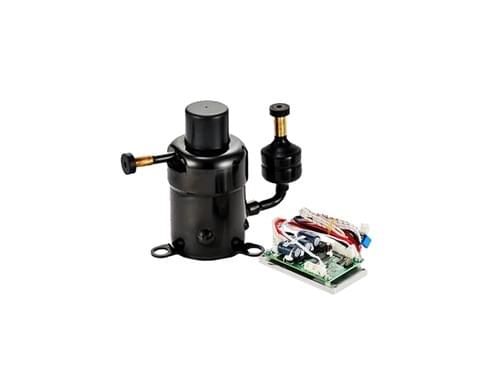
Yes — each unit includes a compatible driver board.
31. What’s the max RPM of inverter DC compressor?
~6,000 RPM depending on voltage input.
32. How to control On/Off?
Use your own switch or connect a thermostat.
33. What’s the noise level of inverter DC compressor?
Below 48 dB.
34. What’s the weight?
~5.5 to 7.5 kg for the compressor only.
36. What’s the operating temperature?
Works well between -10°C and +55°C ambient.
37. How do I recharge refrigerant?
Use the built-in service valve.
39. What’s the lead time?
Samples in 7 days; bulk in 30 days.
40. How can I order of inverter DC compressor?
Online store or direct sales contact quinn@rigidhvac.com.
Standard Products and Custom Solutions
Established in 2010, RIGID is the manufacturer who's behind many popular brands in the US. RIGID's vision is to set the benchmark standard for the micro cooling industry. We are a China manufacturer and supplier of compact cooling systems, working in close cooperation with the leading United States and European manufacturers of Air-conditioning & Refrigeration.
In addition to offering standard products including Micro DC Aircon (ruggedized air conditioner modules for compact and confined space cooling), Liquid Chiller Modules (battery-driven compact refrigeration systems that our customers integrate into their applications), and DC Condensing Units (world's small direct cooling units used by customers in small freezer, medical, laser, and electronics cooling). RIGID also custom design or modify refrigeration systems for most customers' specific applications.
Let our engineering team develop the perfect cooling solution for you!

Certificates | Download | Contact Us | Our History | Return & Exchange
RIGID Technology * © Copyright 2010-2025 * RIGID Cooling * All rights reserved.