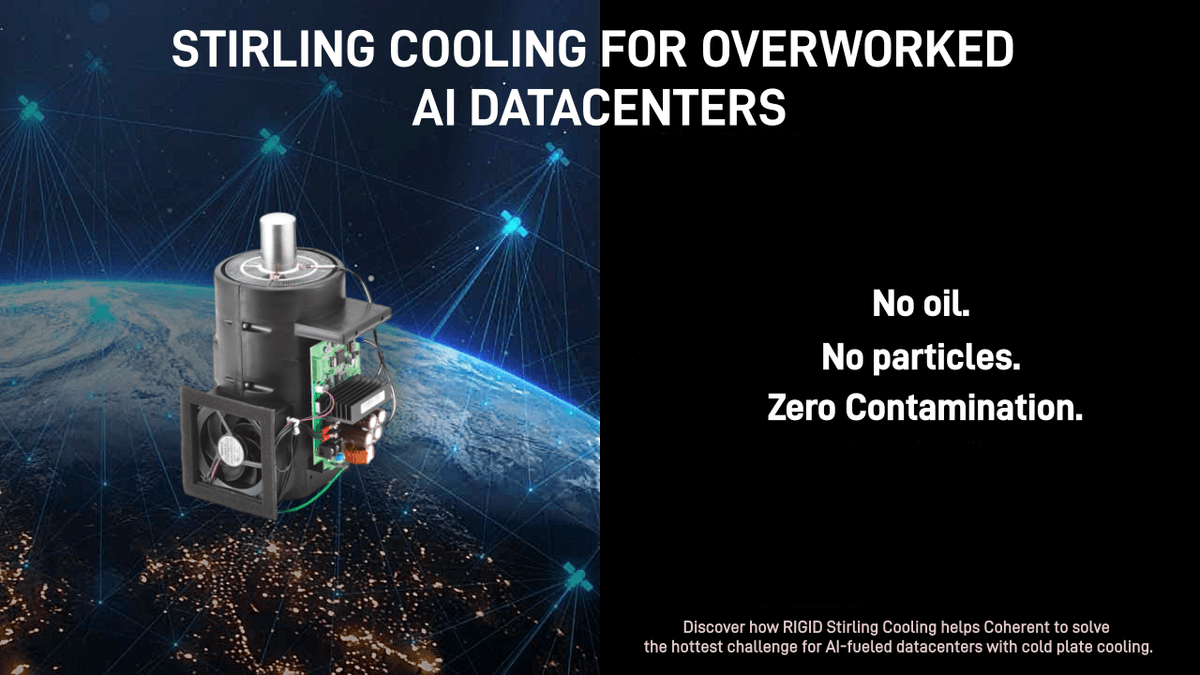
When Coherent’s revolutionary Thermadite™ 800 liquid cold plates demanded a cold source that would never compromise microchannel integrity, the answer was helium, magnetic levitation, and zero oil.
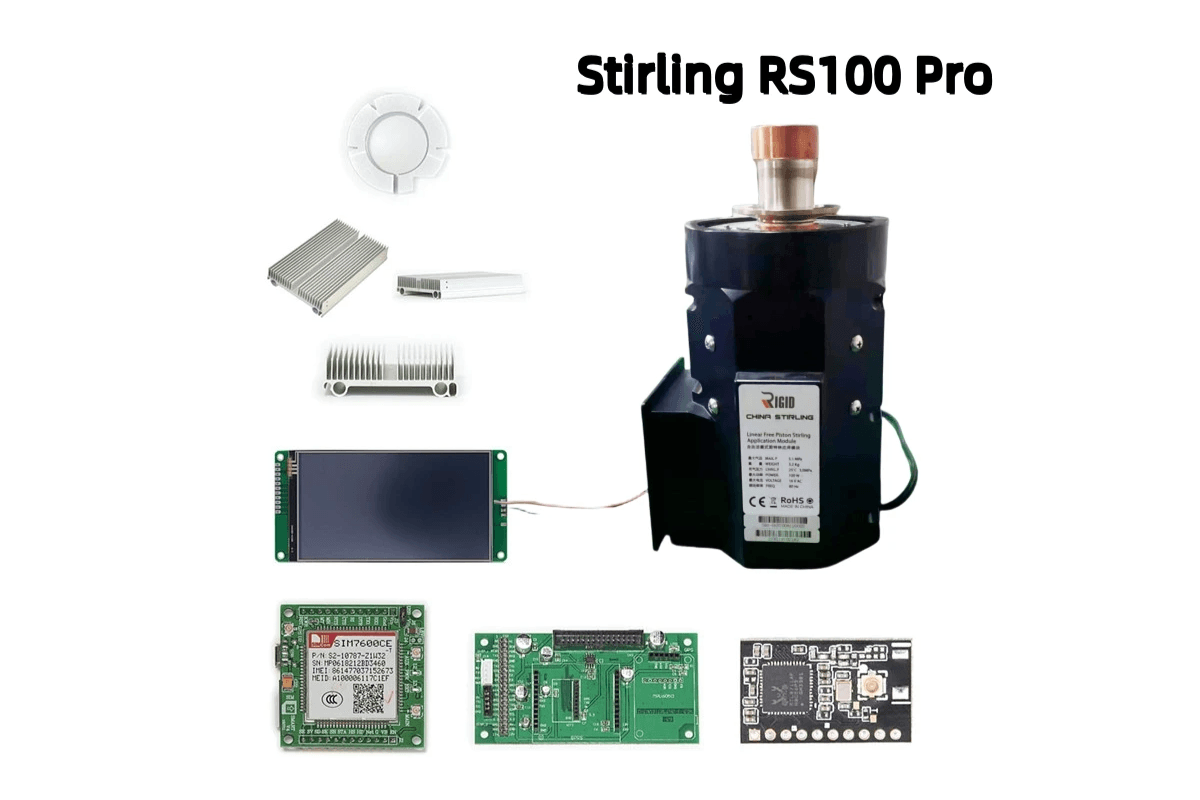
Background
The artificial intelligence revolution is reshaping data center thermal management at the silicon level. As GPU thermal design power accelerates past 750 W — with next-generation accelerators pushing well beyond 1,000 W — liquid cooling has transitioned from an efficiency option to an operational necessity. However, the industry’s focus has largely remained on the cold plate: the diamond-silicon carbide composites, the microchannel geometries, the heat transfer coefficients.
What has been overlooked is the cold source that feeds these plates. And as Coherent Corp. — a global leader in photonics and advanced materials, and a key NVIDIA strategic partner — recently discovered, the purity of that cold source directly determines whether a state-of-the-art cold plate performs as designed, or fails catastrophically at the micron scale.
This is the story of why Coherent selected RIGID Free Piston Stirling Cooler (FPSC) technology for one of their most demanding thermal projects, and why Stirling-based cooling is poised to become the foundational cold source for the next generation of AI data center liquid cooling infrastructure.
1. The AI Cooling Imperative: Heat, Density, and the Microchannel Revolution
Coherent Corp. (NYSE: COHR) has placed itself at the center of the AI infrastructure buildout. In 2025, the company announced a multiyear strategic agreement with NVIDIA — backed by a $2 billion investment — to develop optics technology and scale next-generation AI data center architecture. Central to this effort is Coherent’s thermal management portfolio, and in particular, the newly launched Thermadite™ 800 Liquid Cold Plates (LCP).
Thermadite represents a materials science leap. It is a reaction-bonded silicon carbide (RB-SiC) ceramic composite engineered with diamond inclusions. The result is a thermal conductivity of 800 W/(m·K) — twice that of copper (approximately 400 W/mK), and dramatically higher than conventional aluminum or copper cold plates. For perspective, even Coherent’s own ceramic + diamond SiSiC composite (with 70% diamond) reaches approximately 670 W/mK, while their poly-crystalline CVD diamond hits approximately 1,500 W/mK. Thermadite occupies a strategic sweet spot: ultra-high performance at mass-manufacturable scale.
But thermal conductivity is only part of the story. What makes Thermadite cold plates truly revolutionary for AI accelerators is their complex internal microchannel architecture, optimized to real chip heat maps. These designs focus cooling on hot spot regions, minimizing pressure drop and coolant usage while maximizing heat removal efficiency. The microchannels — internal passages that can be as narrow as 25 to 50 microns — are designed to place cooling precisely where GPU cores and high-density transistor regions generate the most heat.
This microchannel complexity creates an engineering challenge that extends far beyond the cold plate itself: the coolant flowing through these channels must be absolutely pure, and it must stay pure over years of continuous operation. Any contamination — a single particle of debris, a trace of oil, a metal flake from pump wear — becomes a threat not just to efficiency, but to the entire compute investment.
2. The Hidden Vulnerability: Why Cold Source Purity Now Defines AI Uptime
To understand why Coherent’s cold plate architecture demands a new class of cold source, we must first understand the physics and economics of microchannel contamination.
In a direct-to-chip liquid cooling loop, the cold plate is the final heat exchanger. Chilled coolant enters the cold plate, flows through the microchannel network directly above the chip, absorbs heat, and exits to be re-cooled. The effectiveness of this process depends on uninterrupted, uniform flow through every channel. If a channel becomes partially or fully obstructed:
- Localized hot spots form.
The region of the chip served by that channel sees an immediate temperature spike. For AI accelerators operating near their thermal limits, this triggers clock throttling — directly reducing training or inference throughput.
- Thermal stress gradients develop.
Adjacent regions of the chip operate at different temperatures, causing mechanical stress on solder bumps and interconnects. Over time, this accelerates failure.
- Corrosion accelerates.
Particles that lodge against channel walls can damage protective coatings, creating nucleation sites for corrosion. In worst cases, this leads to coolant leaks directly onto multi-thousand-dollar GPU packages.
- Maintenance costs escalate.
Flushing contaminated loops, replacing cold plates, and diagnosing intermittent thermal throttling events consume engineering time and cause unplanned downtime — at a cost that can exceed thousands of dollars per minute in large-scale AI training clusters.
The source of these contaminants is almost always the cooling system itself. Conventional compressor-based chillers and coolant distribution units (CDUs) rely on oil-lubricated compressors, mechanical pumps with bearings and seals, and refrigerants that can slowly degrade or leak. Even with filtration systems in place, trace amounts of oil, metal wear particles, and chemical breakdown products accumulate in the coolant loop over time. Filters can reduce particle count, but they cannot eliminate the root cause — and they introduce their own pressure drop and maintenance burden.
For AI data centers deploying thousands of cold plates with microchannel architectures optimized down to 25 microns, this contamination risk is no longer acceptable. The industry needs a cold source that is intrinsically clean — not one that manages contamination after the fact.
3. Enter the RIGID Free Piston Stirling Cooler (FPSC): A Fundamentally Different Cold Source
This is precisely the challenge that RIGID Free Piston Stirling Cooler technology was engineered to solve. When Coherent evaluated cold source options for their advanced thermal project, they recognized that FPSC technology offers something no conventional compressor can provide: inherent purity, from first principles.
3.1 What is a Free Piston Stirling Cooler?
A Free Piston Stirling Cooler operates on the reverse Stirling thermodynamic cycle, using helium as the working fluid. Unlike conventional vapor-compression systems that rely on refrigerants undergoing phase changes, the Stirling cycle uses the compression and expansion of helium gas to produce cooling. The “free piston” design eliminates mechanical linkages — the piston is driven by a linear electromagnetic motor and suspended by magnetic levitation (MagLev) or flexure bearings, depending on the model.
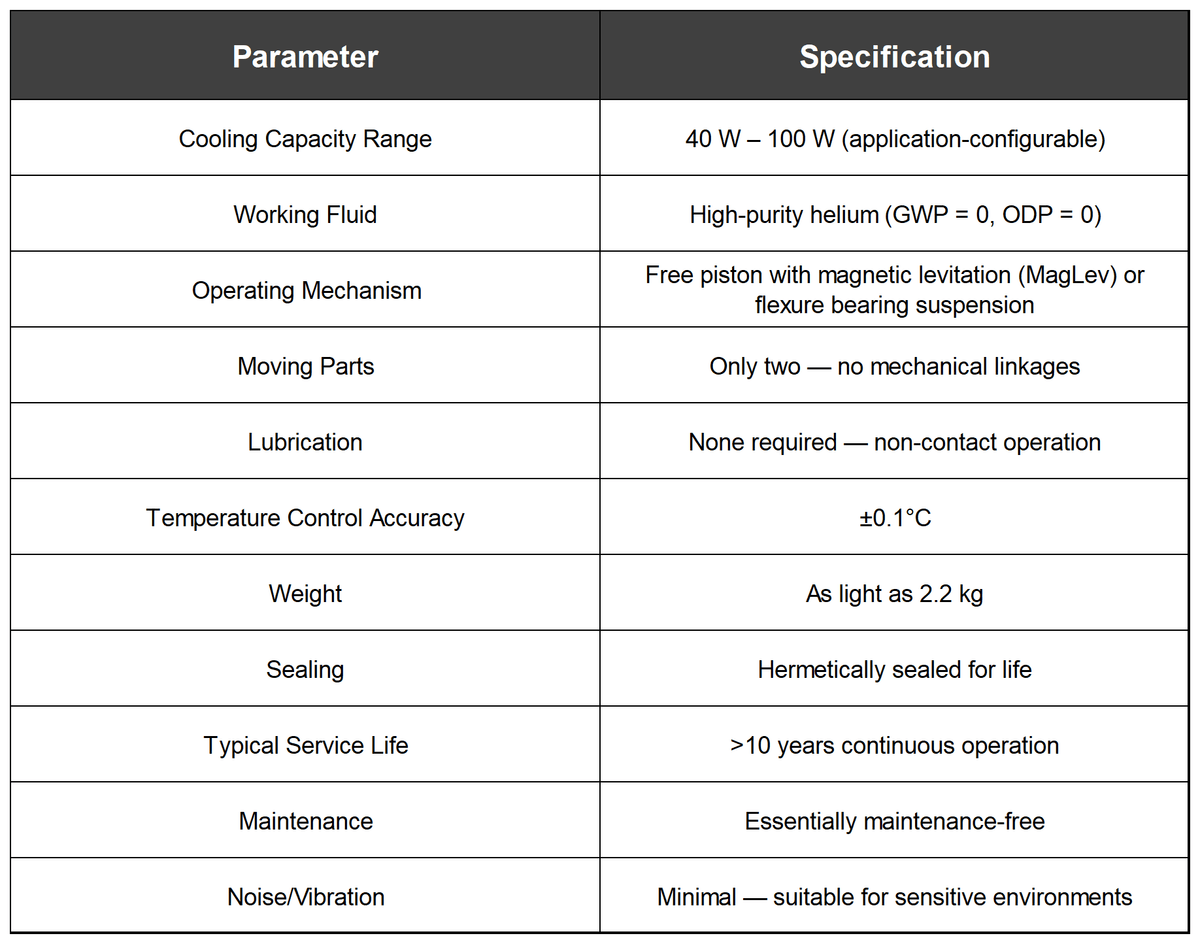
RIGID’s FPSC product line, detailed at https://www.rigidhvac.com/stirling-cryocoolers, offers cooling capacities ranging from 40 W to 100 W at cryogenic and near-ambient temperatures, in form factors as light as 2.2 kg. These coolers are designed for applications demanding high reliability, zero maintenance, and absolute freedom from contamination — from medical and biotech to metrology, and now, AI data center liquid cooling.
3.2 The Purity Advantage: Why FPSC and Microchannels are a Perfect Match
When Coherent analyzed the requirements for a cold source that could support Thermadite 800 cold plates in sustained AI data center operation, several FPSC attributes proved decisive:
Zero Oil, by Design.
In a conventional compressor, oil is essential for lubrication, sealing, and heat dissipation. Even in “oil-free” compressor designs, trace oil migration into the refrigerant stream is a known challenge. In FPSC technology, there is simply no oil in the system — the piston operates without contact via magnetic levitation or flexure support. There is nothing to migrate, nothing to leak, and nothing to contaminate the coolant loop. This eliminates the primary source of organic fouling in liquid cooling circuits.
Helium as the Working Fluid.
FPSC coolers use high-purity helium as the thermodynamic working fluid. Helium is chemically inert, non-flammable, and has zero ozone depletion potential and zero global warming potential. Critically, it does not react with water-based coolants, dielectric fluids, or cold plate materials. Even in the hypothetical event of a heat exchanger leak, helium contamination of the coolant loop poses no corrosion or chemical compatibility risk — an important safety factor for facilities housing hundreds of millions of dollars in compute hardware.
Near-Zero Particulate Generation.
Because the free piston is suspended without physical contact (via MagLev or flexure bearings), there is virtually no mechanical wear during operation. Traditional compressors and pumps generate metal particulates from bearing surfaces, valve impacts, and seal degradation throughout their service life. FPSC technology eliminates these wear mechanisms at the source. For a microchannel cold plate with 25-micron passages, this distinction is the difference between uninterrupted operation and progressive clogging.
Hermetically Sealed Architecture.
RIGID FPSC units are hermetically sealed with only two moving parts. There are no external shaft seals, no refrigerant line connections that can develop leaks, and no pathways for environmental contaminants to enter the working volume. This hermetic integrity, combined with helium’s small molecular size (which actually makes leak detection easier during manufacturing), ensures that the cold source remains as clean on year five as it was on day one.
Precision Temperature Control.
Thermadite cold plates are designed to optimize heat transfer at specific coolant temperatures. Fluctuations in cold source output force the CDU to compensate, introducing thermal cycling stress on cold plate bonds and chip interfaces. RIGID FPSC units deliver ±0.1°C temperature control stability, providing a rock-steady thermal baseline that complements the precision-engineered microchannel geometries of Coherent’s cold plates.
4. Why Not Conventional Solutions? A Comparative Analysis
To fully appreciate why Coherent’s engineering team selected FPSC technology, it is useful to compare it against the alternatives typically considered for AI data center liquid cooling.
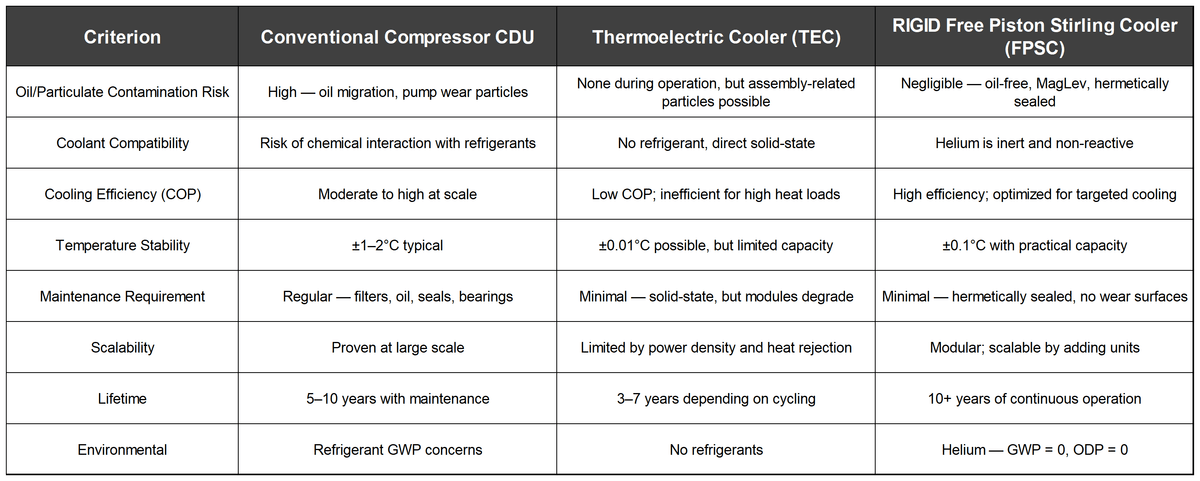
What this comparison makes clear is that FPSC occupies a unique position: it combines the purity and reliability of solid-state thermoelectric cooling with the practical cooling capacity and efficiency of vapor-compression systems, without the contamination drawbacks of either. For AI data centers where microchannel cold plates represent a significant capital investment and downtime is measured in lost GPU-hours, this combination is compelling.
5. The Coherent-RIGID Collaboration: A Technical Synergy
Coherent’s decision to deploy RIGID FPSC technology in their advanced thermal project was not simply a component selection — it was a recognition that the cold plate and the cold source are a system. Optimizing one without the other leaves performance on the table, or worse, introduces failure modes that undermine the entire thermal architecture.
The synergy between Thermadite 800 cold plates and RIGID FPSC coolers rests on three pillars:
Purity Chain Integrity.
Thermadite cold plates achieve their extraordinary performance through precision microchannel architectures. RIGID FPSC coolers preserve that performance by ensuring the coolant flowing through those channels remains free of oil, particles, and chemical contaminants throughout the system’s operating life. Together, they form a “purity chain” from cold source to chip.
Thermal Stability Matching.
Coherent’s cold plates are engineered to remove heat efficiently at specific flow rates and coolant temperatures. FPSC’s ±0.1°C temperature control ensures that the cold plate receives coolant at a precisely maintained temperature setpoint, eliminating the efficiency losses associated with temperature hunting or oscillation. In high-density AI clusters, this stability translates directly into consistent compute performance.
Reliability Without Compromise.
AI data centers operate 24/7/365. Unplanned maintenance on cooling infrastructure can force compute nodes offline. The hermetically sealed, wear-free architecture of FPSC coolers aligns with Coherent’s own reliability standards — standards they have established across photonics, semiconductor capital equipment, and aerospace thermal management.
6. Broader Implications: Stirling Cooling and the Future of AI Infrastructure
The Coherent-RIGID collaboration is not an isolated event. It signals a broader shift in how the AI infrastructure industry will approach thermal management as chip power densities continue their relentless climb.
When Coherent notes that “per server, thermal design power (TDP) has quadrupled over the past 17 years and is expected to exceed 750W this year,” they are describing a trajectory that conventional cooling approaches cannot sustain indefinitely. Immersion cooling — while effective at the tank level — is expensive, complex, and environmentally challenging at scale. Direct-to-chip liquid cooling with high-conductivity cold plates is emerging as the preferred path for the highest-power AI accelerators. And as this path becomes standard, the cold source that drives the coolant through these cold plates will become as critical a design consideration as the cold plate material itself.
RIGID FPSC technology is ready for this transition. With capacities configurable to match CDU requirements, form factors that integrate into existing rack architectures, and a purity profile that eliminates the contamination risks inherent in compressor-based systems, FPSC coolers provide a future-proof cold source for the AI data center industry.
7. About the RIGID Free Piston Stirling Cooler Product Line
RIGID HVAC Co., Ltd is a specialized innovator in micro refrigeration and cryocooler technology. Our Free Piston Stirling Cooler product line represents the culmination of years of engineering in oil-free, helium-based thermodynamic cooling.
Key product specifications:
Our FPSC coolers are deployed in medical cryosurgery, biotechnology sample preservation, infrared detector cooling, metrology instrumentation, and now, AI data center liquid cooling infrastructure.
For more detailed specifications, performance curves, and integration guidance, visit our product page: https://www.rigidhvac.com/stirling-cryocoolers
8. About Coherent
Coherent Corp. (NYSE: COHR) is a global leader in engineered materials, photonics, and advanced manufacturing, headquartered in Saxonburg, Pennsylvania. The company’s thermal management portfolio includes reaction-bonded Si/SiC materials, Al/SiC metal matrix composites, CVD diamond, single crystal SiC, and thermoelectric coolers — serving markets from semiconductor capital equipment and AI data centers to automotive, aerospace & defense, and life sciences.
In 2025, Coherent entered into a multiyear strategic agreement with NVIDIA, including a $2 billion investment, to develop and scale next-generation AI data center architecture. The company’s Thermadite™ 800 Liquid Cold Plates are a cornerstone of this effort, bringing diamond-SiC composite technology to the challenge of cooling the world’s most powerful AI accelerators.
Learn more about Coherent’s thermal management solutions: https://www.coherent.com
9. Conclusion
The collaboration between Coherent and RIGID demonstrates a fundamental principle: when cooling microchannels measured in microns, the cold source must be engineered to the same standard of purity as the cold plate itself. RIGID Free Piston Stirling Cooler technology meets this standard — delivering oil-free, helium-based, particle-free, and precisely controlled cooling that preserves the integrity of the most advanced liquid cooling architectures in the world.
As AI continues to push thermal design power to unprecedented levels, the data center industry will increasingly demand cold source solutions that eliminate contamination at the source — not just filter it downstream. RIGID FPSC technology is ready.
Are you engineering a liquid cooling system for next-generation AI hardware?
Contact RIGID’s thermal solutions team to discuss how Free Piston Stirling Cooler technology can be integrated into your CDU architecture and cold plate loop.
Coherent & RIGID: Pure Cooling for AI | Stirling Cryocooler
📧 Email: quinn@rigidhvac.com
🔗 Product Page: https://www.rigidhvac.com/stirling-cryocoolers
🔗 Coherent Thermal Solutions: https://www.coherent.com
About RIGID HVAC Co., Ltd: RIGID is a leading innovator in micro refrigeration and cryocooler technology, specializing in Free Piston Stirling Coolers (FPSC) that deliver oil-free, helium-based, high-efficiency cooling. Our coolers serve medical, biotech, metrology, advanced industrial, and AI data center liquid cooling applications — where purity, reliability, and precision are non-negotiable.
#LiquidCooling #AIDataCenter #StirlingCooler #FreePistonStirling #FPSC #ThermalManagement #MicrochannelCooling #DataCenterCooling #SemiconductorCooling #HeliumCooling #CleanCooling #DataCenterCooling #Coherent #HPC #AICoolingSolutions